


It will remain an eternal mystery why different Nintendo wants to keep Americans and Europeans separated in Rhythm Heaven and Rhythm Paradise, but either way they want Switch and Switch 2 gamers to get their groove on. It’s been basically a decade since the last game landed on 3DS, and Rhythm Paradise Groove brings some fresh modes to the table.
At the beating heart of Rhythm Paradise Groove its traditional sequence of disconnected minigames, which range from the banal to the eccentric. Built around that, the is broadly divided into solo player and multiplayer games, with a smattering of modes in each and a few other little bonuses to explore,
On the single-player side, the main offering are the solo minigames and Beatspell. In the former, what you’ll be doing differs wildly from one moment to the next, from catching a frisbee as a dog to conversing with an alien. The key point is that these are all performed to the beat, with successful runs garnering you a little medal for your troubles. Once you complete four, you unlock a remix stage that blends the previous set of games together.
It’s odd because I sometime found myself bombing the individual games entirely, only to get into the groove better in the remix, or vice versa. I can’t seem to succeed at stages that involve a character jumping either. I know it’s to the same beat, but I just cannot seem to do those effectively, and don’t even get me started on the Yum-Bot Simulator stages.

The great thing is that with so many stages in this mode, you will very likely find a few favourites that you want to go back to and score chase a little. This is how I spent most of my time with the game, trying to get that elusive perfect run in my favourite stages. The problem with this being that, once you have done that, there’s no reason to return to the stages again. As robust as this mode seems, the replayability is actually rather low.
Beatspell, however, is a slightly different beast.
In Beatspell, you awaken as an amnesiac magician tasked with defending a kingdom from dangers, battling foes and casting spells tapping button prompts to the beat. Each spell has a different button combination and beat, so you must keep in time to the rhythm to be effective as you whittle down the health of your enemies.

You can hold up to three spells at once, which you can switch out on the chapter menu, and you need to be strategic with your loadouts as certain enemies will have resistances or weaknesses to specific spells. The result is a mostly satisfying little rhythm adventure that only slightly broke my brain. I just could not get the timing right for some of the spells, resulting in some very tense encounters.
My only problem with Beatspell is that I just don’t feel like it quite hits the heights a game like this could. Having played other rhythm-RPGs such as Crypt of the Necrodancer, or even comparing it to a Patapon or Ratatan, this mode feels over simplified in comparison. Don’t get me wrong, if there were further stages for this mode released, I would love to play more of, but Beatspell just doesn’t hit the potential I saw in it initially.
Over on the multiplayer side of Rhythm Paradise Groove, you have fewer games overall, but far greater longevity. First off, you can register the players so it calls out their names during gameplay. This results in a similar sort of hilarity to putting in names at a bowling alley, before you even get to the games, although I didn’t experiment with how far you can take this. I personally preferred the co-operative games, such as Ninja Bodyguards, but there’s also several competitive mini games to beat your friends at (pun intended).
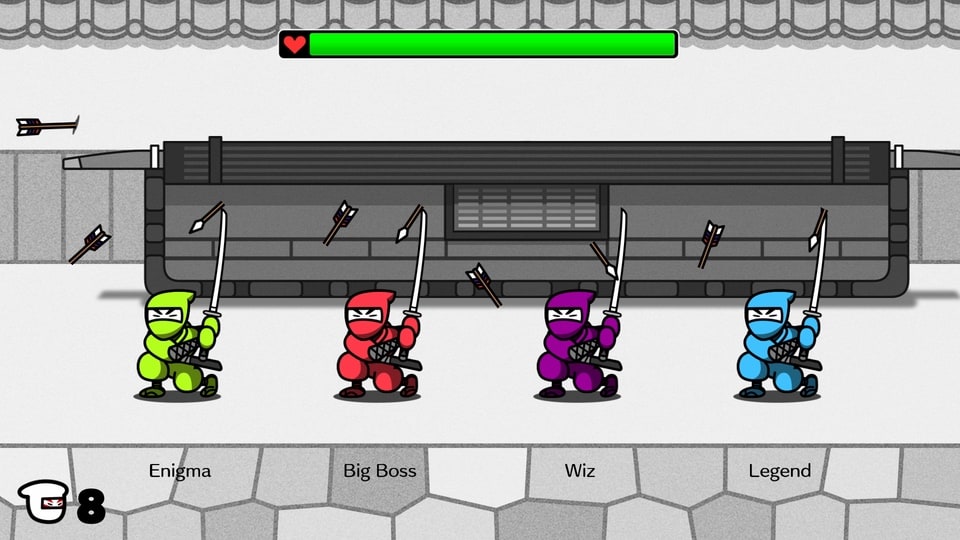
Adding additional players to the mix just creates a more unpredictable environment, which really increases how replayable it feels, even if there’s the exact same degree of simplicity to the gameplay.
Much like the solo games, your score at the end will determine whether you get a ring (this mode’s equivalent to medals) and unlock further games to play, but if you’re anything like me, you’ll keep returning to these games a lot. I would thoroughly recommend Cake Wait with a full group of four huddled around the TV. It’s far more intense than it has any right to be.
Visually, Rhythm Paradise Groove can be described with one word: wacky. It’s bright and colourful, sure, but the entire game delights in throwing out increasingly weird imagery. You can be a row of little round guys jumping through hoops, trying to sneak past a moon as it sneezes, or part of an air-based delivery service. Each one is imaginative and sometimes very funny, like the little cats jumping up to grab veggies you drop in Slice N Dice.

I also have to commend this game’s audio. The songs are incredible throughout, spanning multiple genres, and are spectacularly catchy. This you would expect from a rhythm game, but they did not have to go this hard when minigames come and go so quickly. I’m sitting with one of the tracks stuck in my head as I’m writing this (Slice N Dice Kitchen is the current song, if you’re wondering), and I’ve had one song or another rattling around in there since I started playing the game.
But a key thing for me is the Read-Aloud Settings. Not only can you have the game read out everything, but the game even has audio description. This level of consideration for accessibility is increasing across the industry, but I cannot recall another instance where it’s been seen within this genre. Just this little touch makes this game approachable for a lot more people and there’s something incredibly laudable about that.