
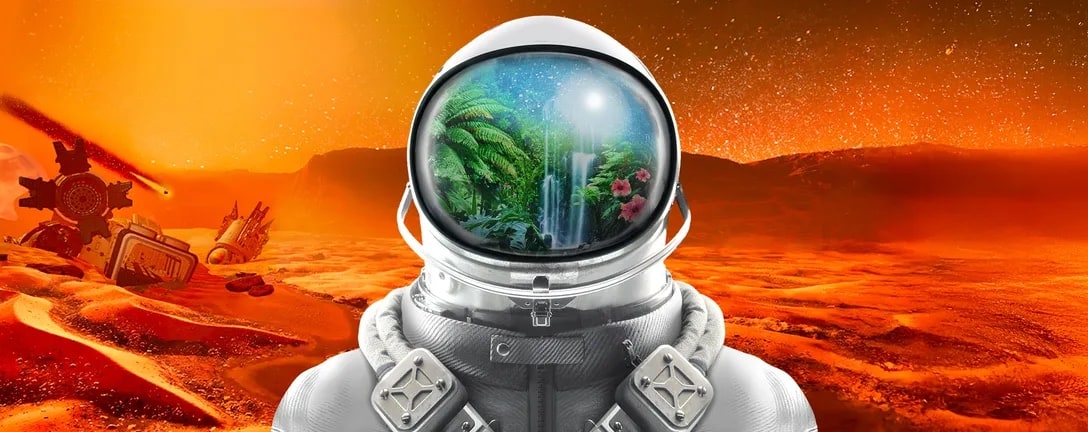
The Planet Crafter is a survival game. Starting with a barren wasteland of a world, you have to not only find resources, grow food and build shelter, but drill to release pressure, place heaters to raise the temperature and gradually turn it into a verdant paradise that can support human life.
It’s a pretty cool idea, and it sounds incredibly grand and complex. It is, but it’s also fairly straight forward as the main addition to the core survival mechanics is that you’re also placing terraforming contraptions. You still have to overcome the familiar survival game tropes of a slow start and a lack of storage, and this feeling persists longer than is necessary. Items don’t stack ever, so your inventory fills up exceptionally quickly, and your basic storage chest is smaller than your inventory. It leads to far too much fiddling with inventory and sorting things into chests.
This stage of the game almost exclusively involves picking up resources from the ground, and then running back to base before your abysmally small oxygen tank runs out. The wilderness is littered with chunks of iron, cobalt, magnesium and other elements, sticking out of the ground like plants, with little rhyme or reason to their placement. If you need a particular thing, you can just run in a random direction until you see it.
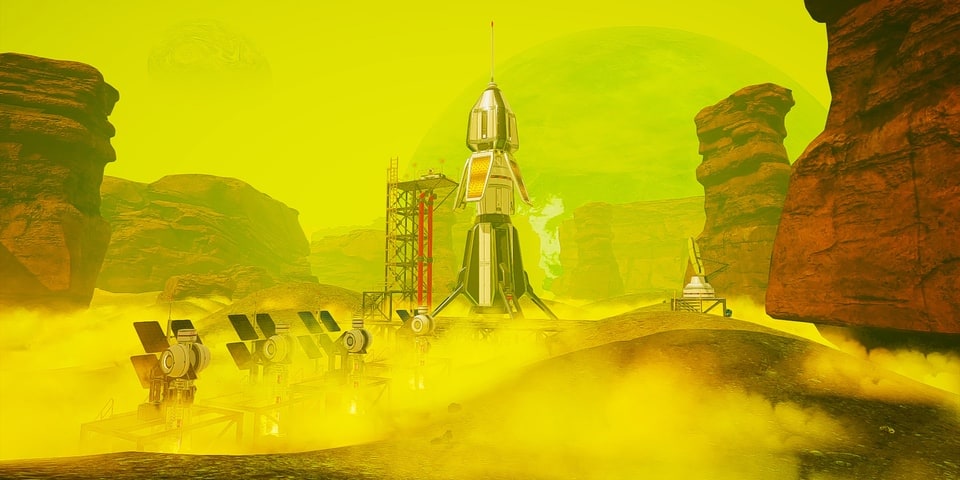
Improving your situation all depends on the terraformation index, a number in the corner of the screen that you need to keep growing to gain later unlocks. Want a slightly bigger oxygen tank or upgraded storage chests? You’ll need to keep placing drills, heaters, plant spreaders, and you’ll keep unlocking better ones with which to replace them. Different aspects of terraforming have their own rewards too, with heat, pressure, plant life, etc, all having their own treadmill of unlocks to work through. These are a bit jumbled up, so you might unlock a new drill that releases more pressure by improving heat rather than pressure, for example. This means you can’t just pick one and super specialise, because the terraforming growth will seem to slow to a crawl and, more importantly, you’ll be missing crucial equipment.
You do eventually unlock better ways for basically everything. You can get a jetpack, which will speed your traversal up significantly, but not as much as a vehicle which even has an upgradeable chest on the back so you can carry even more stuff! Add a couple of speed upgrades and you’ll be cruising across the planet with all those previously lengthy, O2-risking strolls in the rear view mirror. Or there’s the drones, a late game construction which allows you to automate all your item storage. Or rockets, which can add literally 1000x multipliers to your existing pressure/heat/etc. values, which is invaluable once you get into the higher tiers of the terraformation index.
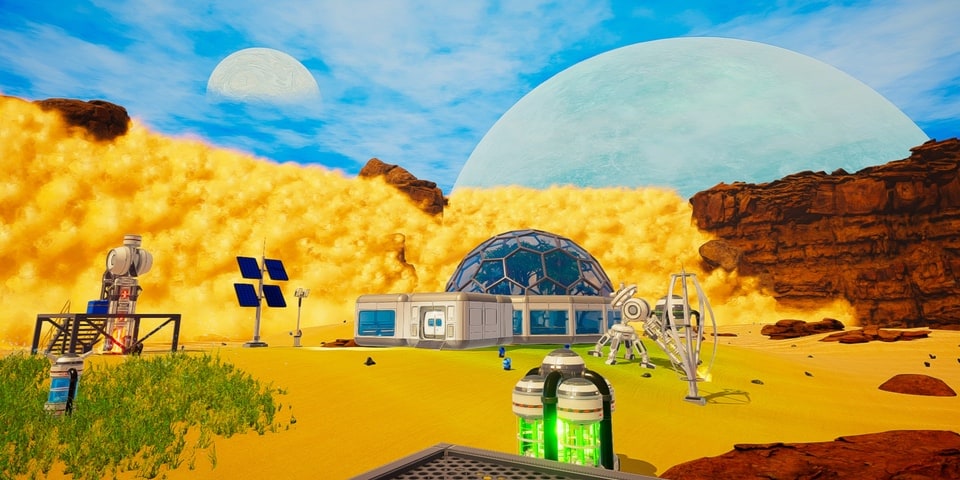
But all these things appear many hours into a run, so you’d better be content with a lot of grinding. And you know what? I actually am OK with it. Maybe it’s because you’re always progressing in that Cookie Clicker kind of way, where you’re affecting the rate of change, or maybe it’s because you can see what will unlock and when, so you can plan how to prioritise things rather than just guessing. Finally reaching an upgrade or key piece of equipment can feel like a real game changer, and it doesn’t hurt that you get to watch the barren world slowly develop a blue sky, form lakes, and even feature a breathable atmosphere. You can’t imagine how big that is in a game where the main limiting factor was the size of your oxygen tank.
The Planet Crafter can really worm its way into your mind. Even as I write this, I’m planning a super alloy farm in my head, which will then be made into super alloy rods to be transported by my drones to my main storage. Not to mention that I’ve got to upgrade all my chests to the fancier version I’ve just unlocked and install a third speed booster on my already dangerously quick buggy. I haven’t even mentioned sequencing genomes for bees, butterflies, silkworms, and all the other flora and fauna on this world, or the mysterious backstory to the planet that you slowly uncover while exploring the map. Oh, and I haven’t mentioned sending up GPS rockets to give yourself a map, then another rocket to add resource deposit info to that map – another paradigm shift in how you play the game.
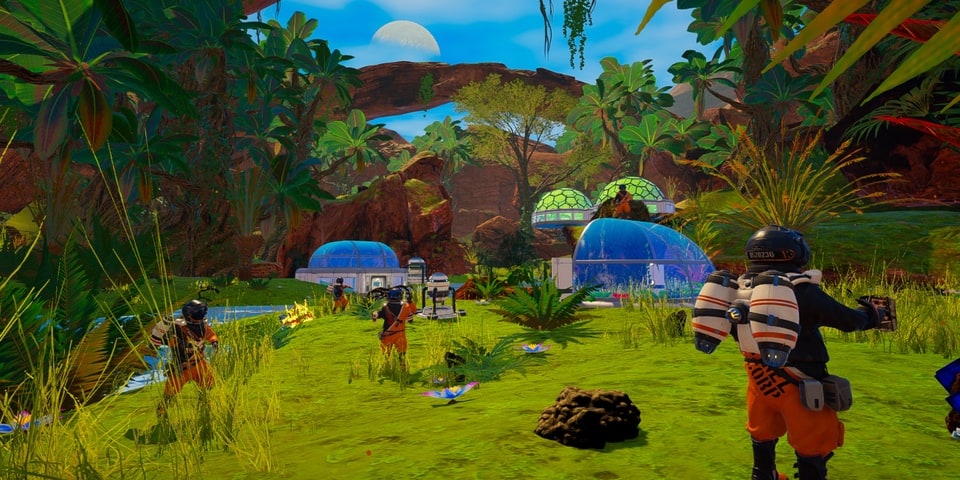
Unfortunately there are still nagging issues. While it’s generally good enough visually, this game is not much of a looker, especially early on when the planet is desolate and bland. Even once foliage covers much of the land and there’s variety with lakes and life, heading to the edge of the map takes you to a land of blurry, if not solid colour textures. That’s a shame because it’s quite fun to explore when at speed.
The buggy controls are strangely finicky as well. Sometimes it just…stops accelerating, forcing you to reverse slightly to get it to go forward again for some reason, which is tricky when you’re using it to get up a mountain. It also has inconsistent collision physics, sometimes passing right through things and others bouncing off them or up into the air. The camera in third person has a bad habit of cutting through the landscape and showing the abyss beneath, or sometimes a cave nearby – actually this is quite helpful.
And generally, the UI is pretty basic and lacking in quality of life features, such as auto-moving resources or crafting from inventory in nearby chests – something the autocrafter can do, but you cannot. The biggest issue with it was when trying to use drones to move multiple specific objects into a chest at once – each one has to be added from a single menu of every item in the game one at a time, and the menu closes after you select one. It’s probably fine on PC with a mouse, but using a controller with no sorting or categories, it’s pretty dreadful.