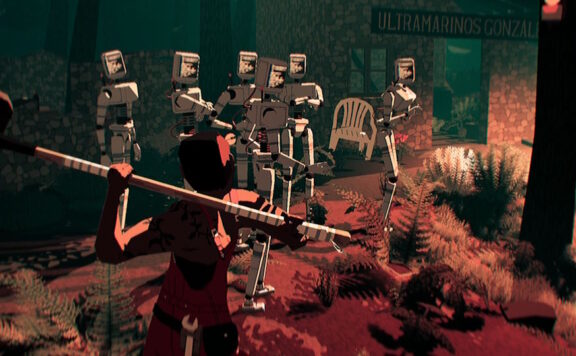

What makes you human? That’s the core question at the heart of Virtue and a Sledgehammer. Granted, you may not expect a game where you are smashing up a town filled with robots to pose such an existential question, yet that is exactly what you are getting into as you step into the shoes of Pratelle. She is on a mission to destroy her hometown where the only inhabitants left are robots.
Usually, when a game pits humans against robots it’s about saving the day and being a hero. Virtue and a Sledgehammer is more complex than that. You see, these are not just any robots that now walk around town. They carry the digitised memories and personalities of your old neighbours, who sacrificed their human bodies one by one to live forever in robotic shells that they can transfer between for eternity. The cause of this change is Nina, Pratelle’s sister, whose life’s work made this possible. Nina sees this existence as the future of humanity while Pratelle sees the robots as nothing but mimics that are missing that human spark. So she picks up a sledgehammer.
Virtue and a Sledgehammer is a pretty linear affair, lasting approximately four hours, in which you walk through town breaking down buildings in search of the robots and memories. The town is littered with crystalised memory shards, with reds one being small parts of a whole memory while blue crystals are whole memories. As you collect these shards and watch the memories you come to learn about both Pratelle and Nina’s pasts along with their relationship with each other and their mother. Collecting these memories is one of the main parts of the game to build the narrative. Sure, you could try and avoid most of the shards if you want but then you’d be missing out on the whole story.

At first, smacking robots and wrecking buildings with the sledgehammer is pretty satisfying, but then it starts to become uneasy as you read what the robots are saying. Are you going to listen to the robot that wants you to kill him along with his family that he has locked in their home? What about the robot that used to be a kind old man who just wants to spend his time growing a garden and bringing more nature to the world? How about the robot that begs to be spared because they had a degenerative disease as a human which meant they could not walk, but now they can? Do you follow through with Pratelle’s mission to destroy all the robots or let empathy wash over you?
Some of the robots you won’t have any qualms about smashing to pieces though, because they attack you. Some absolutely despise Pratelle, just like they did in real life because she’s a lesbian and half Arab. Those always felt my sledgehammer’s wrath. With this, Virtue and a Sledgehammer tests your lines and makes you question what you find acceptable. Is a robot gardener really such a threat that it needs to be destroyed, or you can you leave it be? Is violence really acceptable against a robot that mocks you but doesn’t physically attack you? Would you be asking these questions if Pratelle was using a sledgehammer against a flesh and blood human? It’s these moments where Virtue and a Sledgehammer shows its narrative nuances, forcing you the player to evaluate your thoughts.

Pratelle, Nina, and their Mama are decently written characters, though even with the exposition there is not as much depth to this trio as I was expecting. Nina is ever the scientist striving for perfection, Pratelle is much more focused on the soul, and Mama is the central cause for both of their decisions.
Virtue and a Sledgehammer’s gameplay is pretty simplistic. You walk through different parts of town to wreck it. The sledgehammer is not a weapon that is viable for quick attacks. Pratelle slowly lifts it into two different positions, a sideway swing that can take out most of the standard robots, and an overhead swing that targets the crawling robots and the larger ones that hulk over her. You have to wind these attacks up which usually means putting a bit of distance between you and incoming robots until they are in range. Pratelle can push them away too to give a bit of breathing space.
The destruction of the buildings is pretty good and it can feel like a job well done when you have dismantled a larger building wall-by-wall, but you will notice parts of the building stuck in midair or pieces of rubble not reacting as you walk through it.

Virtue and a Sledgehammer’s visual design is pretty good and has an aesthetic that harks back to PS2 graphics with a bit of a blocky nature. Different parts of town have their own identity to signify what they represent, and the areas are well laid out – navigation is straightforward with exits to the next area clearly signposted by a flashing red light. The music is good for the most part, though in one section the vocal harmonic went on a bit too long, because the walk seemed to go on for a while, though a later similar kind of section is much better done as a Spanish song plays.