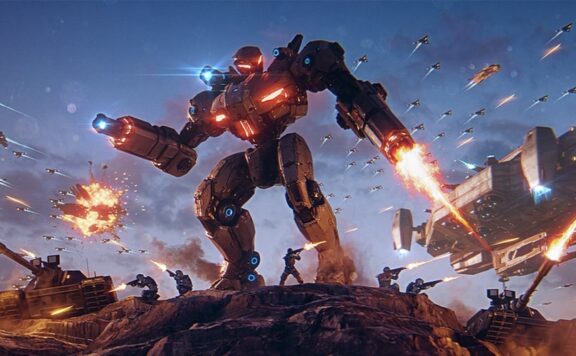
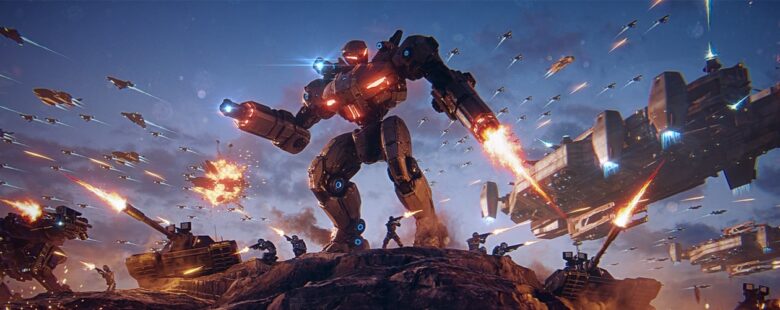
While it might be set in the sci-fi future, with robots, drones and battles across alien worlds, Ashes of the Singularity was pretty prescient when it first released in 2016. Billionaires decided to check out from Earth, upload themselves into computers to live forever, and then went to war amongst themselves and against the sentient AI that had made this possible for them. Classic billionaire stuff, in other words. Ashes of the Singularity II sees the flesh-based people back on Earth deciding that they’ve had enough, adding a third faction into the mix that is looking to fight back against the Post-Human Coalition and the AI Substrate for their past and present transgressions.
The campaign follows the United Earth Force through the instigating events and rapid push through the solar system. It all starts because of some PHC running wild, effectively terraforming parts of the planet and covering the Moon in the Turinium, which supports their digital life, with the major nations of the world finding themselves startlingly outmatched. This failure sees them banding together, uniting in the cause to stamp out the PHC overreach on Earth, but as the UEF pushes on, their resolve and reasoning for continuing the war are tested in various ways.
There’s a glimmer of something really interesting here, exploring what it means to be human, whether the Post-Humans are actually alive, the shifting allegiances of individuals, but it’s all over far too soon. There’s just a single 10-mission campaign for the UEF in the game at launch, and it spends much of that time building up to the full-scale battles that are so distinctive of this type of RTS.
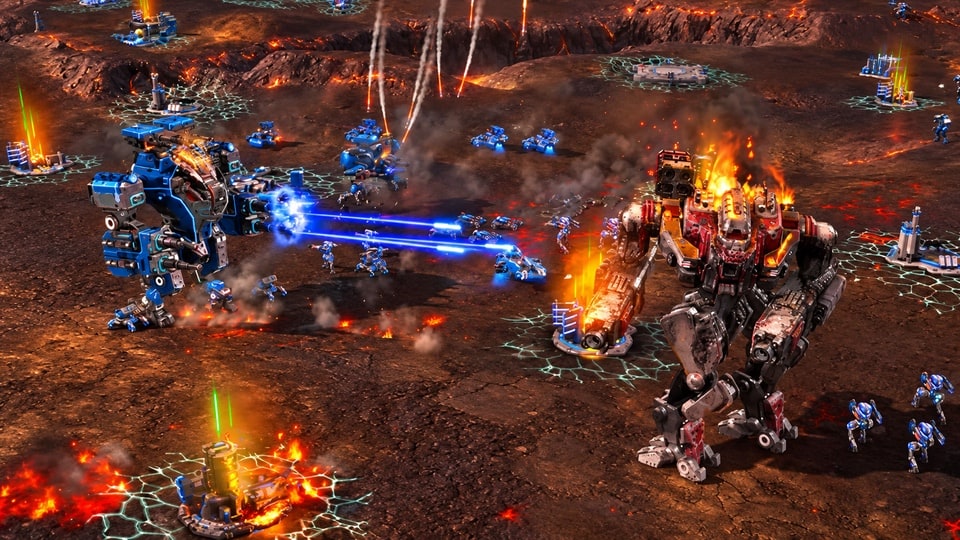
If your primary enjoyment in an RTS comes from playing through a campaign and its curated scenarios, then Ashes of the Singularity II comes up short. If, on the other hand, you love to take on custom skirmishes, test yourself against increasingly difficult AI generals, or head online to battle and/or team up, then this game could be worth your time, and there’s significant evolution to the core RTS gameplay compared to the first game.
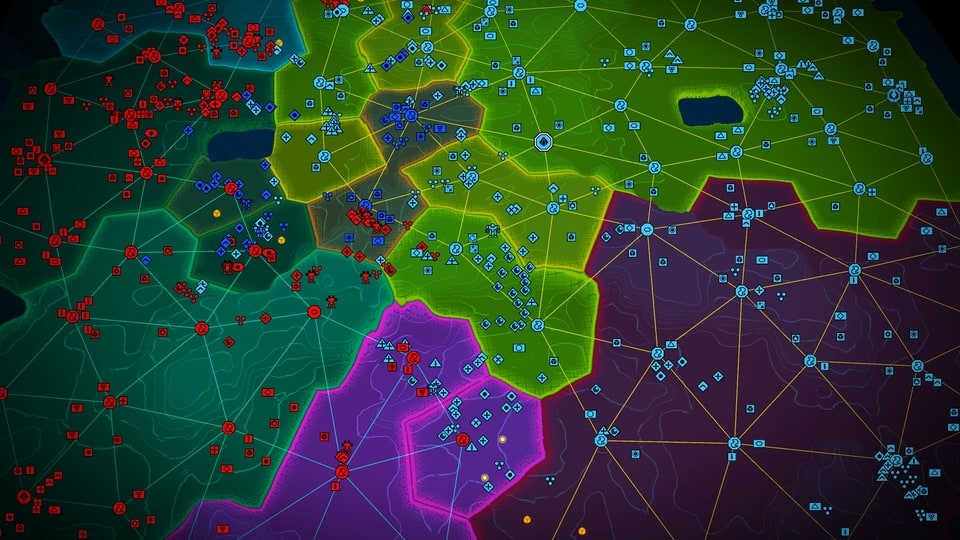
As with the original, this is a macro RTS in the vein of Total Annihilation and Supreme Commander, but Ashes of the Singularity II tries to push that feel further. The map is now broken down into regions for each of the control points and the resource nodes, and instead of needing to (find and) send worker bots around to build everything, the captured point has its own little team of drones to do that for you. It dramatically streamlines the build up of your economy, as you can simply dip into the build menu as soon as a region is captured and rapidly place the resource gathering buildings, defences, and construction buildings you want and need.
You do still need to be aware of how you’re spending resources, with each region having its own power output, which defines what and how much you can build there – though you can upgrade the node to provide more power, as well. I soon settled into trying to spread defensive turrets across region borders, and dotting manufacturing around in a similar fashion.
The other side to this is that it frees you up to focus on your armies, and here’s the other major streamlining change. Everything is now grouped into armies, as opposed to heading to a rally point and needing you to manually assign things into command groups. Instead, the army itself is the rally point, so soldiers, tanks, walkers and aircraft will all head directly to where you’ve told that army to be or go. You can amend an army’s makeup at any point, dipping into a Recruit menu and adding or removing units, and you can either manually replenish or have an army auto-replenish, which will start to recruit from the nearest buildings.
It’s a great twist, and it does mean that you can have this pitched battle for a control point between equally matched armies and defences, both sides having the manufacturing close to the front line and endlessly churning out more units to head into the fray.
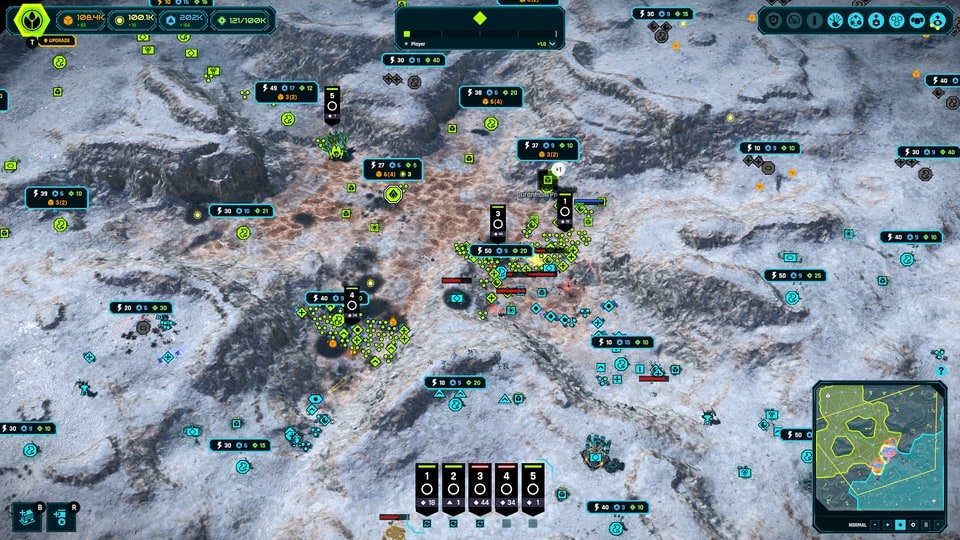
At least, that’s the theory. In practice, two armies clashing for the first time will see the balance tip one way or the other after a few minutes, and it can be really difficult to stop that from snowballing. Or, if there are two evenly matched armies, whoever has the better resource-gathering efforts will be able to build up a secondary force to sweep through or flank while the other side is just trying to keep their heads above water. There’s less of an emphasis on actions per minute (APM), but that doesn’t alter the fundamentals of the genre.
There are some nagging annoyances that I do have with the game. My most persistent grievance is with the keyboard binds, where the AOS2 now supports WASD for camera panning in addition to the arrow keys, but then also maps that left side of the keyboard to the build and recruit menus. I am still constantly trying to shift the camera once I’ve entered these menus and selecting buildings or units and having to back out again. You can rebind them, of course, but it’s an annoying default.
More work also needs to be applied to the UI when zooming out to the topographical battle map view. The jumble of unit and building icons takes a while to learn to read, but they get in the way of seeing where to place resource buildings, and you can all too easily just get a denial noise when placing a building in this view, because the terrain is blocking it.
And generally, I would also like to see some kinds of formations, facing and target prioritisation for the armies. As it is now, it just feels like a vague scrum of units and attack move orders are simplest.
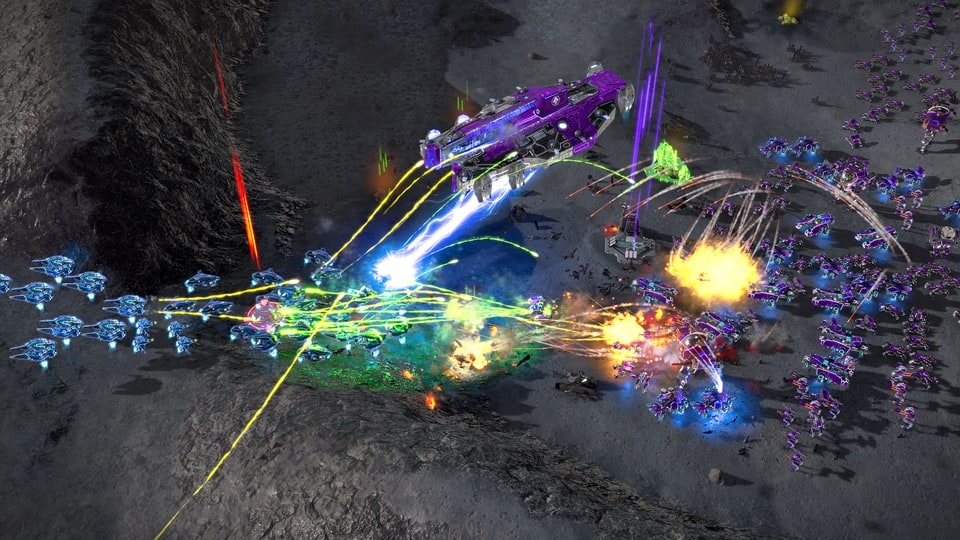
There are some good distinctions between the three factions. The UEF feels like a blend of conventional military with some big stompy mechs, the PHC has more specialisation and overt sci-fi hover tanks and hero commanders that can boost an army’s role, while the Substrate can lean into more numerous swarms and has a big floating Avatar as a one-off perishable commander. While it helps keep things manageable, there’s not a huge breadth of unit types and roles, and only a few unit size layers to progress through.