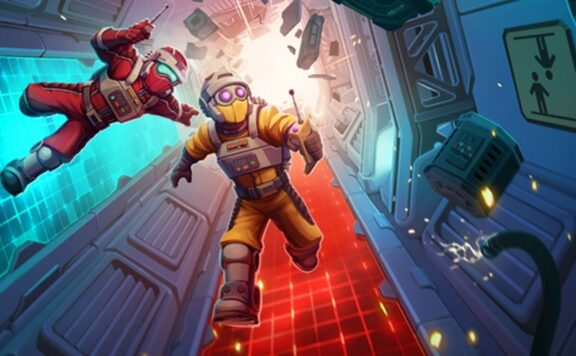

When you’re five games deep into a series, you generally know what to expect, and We Were Here is no different. The co-op puzzler has hung its hat upon walkie-talkie communication, split views and a story about a king gone mad, a jester, and a frigid arctic setting. We Were Here Tomorrow, though, makes a leap from the fantasy to the sci-fi in its setting, and brings some key new gameplay ideas to the table.
That shift to a retro futuristic sci-fi setting is easily the most distinctive aspect of We Were Here Tomorrow. It’s a nice and chunky take on the style, like the whole world is made out of the soft touch plastics, instead of obsessively shiny environs I feel we see a bit too often in this era of ray tracing and reflections. It’s nice, in other words, but the game also takes this aesthetic and still explores some wild changes in setting, as you explore the Norcek Industries facility across multiple eras.
You see, instead of the mad king, we kind of have science run rampant. There’s a slew of rifts that Norcek has been experimenting with, trying to solve the world’s energy crisis, and they need some volunteers to go and investigate the phenomena that the rifts have created. Lucky for Director Kathleen Bowe, she’s found the two of you frozen in the Antarctic and reckons you owe her one for thawing you out.
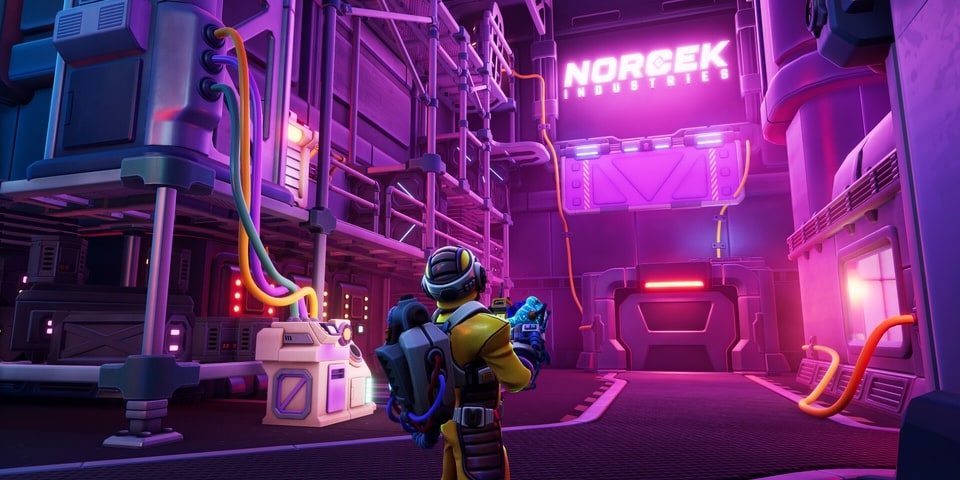
Norcek has been able to come up with some handy gadgets to use while exploring, with each player getting a different gun-like tool. They’re not guns, though, with one being a gloopy grabber-type tool and the other able to chuck metallic blocks around. Not, on the surface level, the most exciting gadgets, but just like the very specific things that Q puts in James Bond’s watch, they’re exactly what you need, gaining additional abilities, such as channelling electricity or producing more blocks.
The positive here is that it allows for more variety in how the game’s puzzles are constructed. You can have your own distinct roles within a shared space now, as opposed to being locked away in separate rooms, or be divided still, but using these tools to affect the other side in some ways. It does, however, mean that you can be a bit pigeon-holed into a particular puzzle type – swapping tools is possible between some chapters, but then you would have the upgraded version and probably don’t quite know its capabilities.
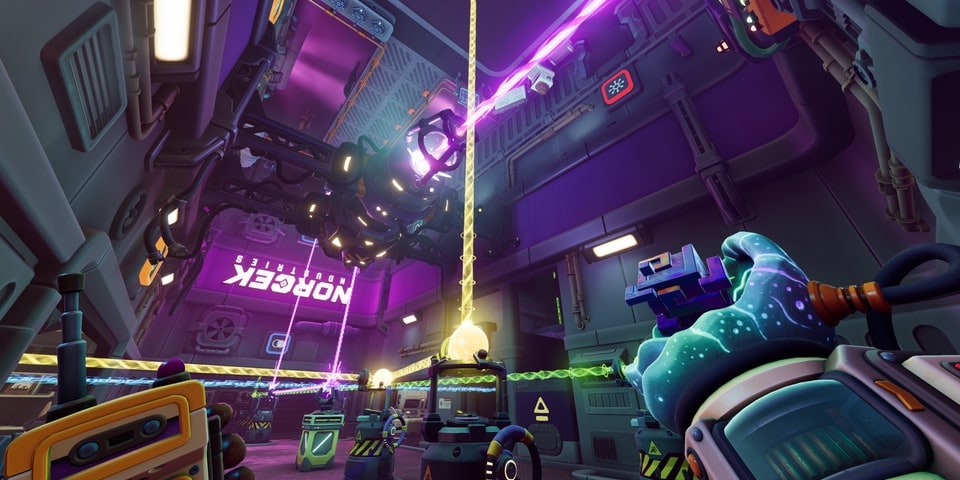
As with the previous We Were Here games, there’s an emphasis on walkie-talkies and communication to solve the co-op puzzles within the world, though this is by far the most easy-going game in that regard. You’ll spend a good chunk of time sharing the same space or being close enough that you can talk via simple proximity chat. It’s so easy-going, in fact, that it sometimes becomes a bit of a surprise when the walkie-talkie is raised by your character to suggest that you’re now too far apart and need to use it to chat.
You’ll make plenty of hot air while playing, but the real challenge is figuring out how best to communicate with your co-op partner. You’re constantly seeing different views of the world and needing to describe different symbols and configurations, which is sometimes a little easier said than done if you can’t agree on which symbol looks like a snail, or which one’s like an old radio.
One of the difficulties for We Were Here Tomorrow is that we found a few instances where we struggled to overcome that, where we – OK, I’ll admit it was mainly me – couldn’t quite grasp the key rule or point of the puzzle. Similarly, there’s a few puzzles where it feels more like one person can or needs to solve it, as opposed to a more natural back-and forth.
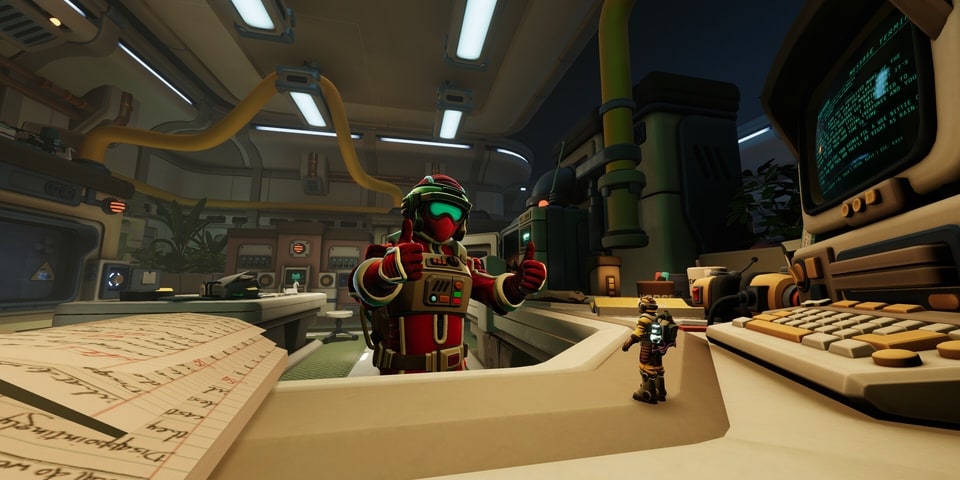
But then there’s puzzles that are just really enjoyable or visually appealing. A Norcek office where pathways wrap around onto walls and ceilings and you can just walk along them –which can be tricky if you deal with motion sickness – a time loop where you can record actions and time subsequent runs to coincide, or one player being shrunk down to run around inside of machines and electronics.
It’s a shame that there were a few nagging annoyances and issues that did get in the way of these high points. At launch there was a lack of checkpoints, voice chat connection issues, a lack of motion sickness accommodation, and mantling up to ledges is inconsistent. Total Mayhem Games has released a series of patches now that aim to address these areas and generally fix bugs.