

I’ve saved the Princess. I’ve beaten Ganondorf, Robotnik and the Reapers. I have been a hero any number of times, but only one of those games let me decide to be one. The thing is, given the option I will always play, not only the hero, but the most squeaky-clean boy scout possible. And in some ways, it’s ruining games – and even entire franchises – for me.
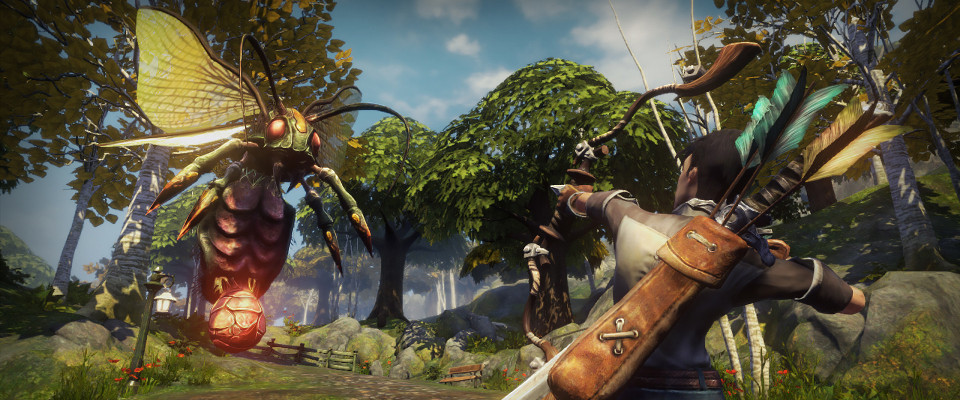
My first encounter with a moral system in games was the original Fable. I loved the idea that your actions molded your character’s ability, as well as their appearance and how others responded to you in the world of Albion. I immediately opted to make every ‘right’ choice, shying away from anything that might taint my character’s good standing, avoiding whole quest lines in order to stay pure. The glowing halo and butterflies that surrounded my character by the end of the game were proof of my piety. Vintage spoiler alert – saving my sister at the close was no choice at all.
Around the same time I played Star Wars: Knights Of The Old Republic for the first time, and again the supposed moral choice was incomprehensible to me. I thought ‘Who wouldn’t want to be a Jedi Knight?’ and set about saving the galaxy in as perfectly righteous a manner as possible. Given how important the films were to me while growing up perhaps that affected my outlook. I never thought Darth Vader was cool – even if he did sound like James Earl Jones – and Emperor Palapatine wore the strictures of the Dark Side across his face, who would want that? The temptation was simply never there, and while Yoda was a backwards-talking Muppet, he knew how to live.
Perhaps it all boils down to why I play games; entertainment, fun, overcoming a challenge, all take a part but being a hero is crucial. Trouncing evil, saving the kingdom, was the plot of nearly every book, comic or film as I grew up, and whether it was The Last Starfighter, Spiderman, or Dune, I would have always been rooting for the good guy, knowing with a degree of certainty that they’d ultimately succeed.
Don’t get me wrong. I know that the world isn’t like that, and that almost everybody functions with areas of grey in their lives, the extremes of such a good, or bad, life would almost certainly be unsustainable. However, gaming isn’t real life – however much of a portion it might take up – and given the opportunity I just want to be the hero. Everyone likes a hero, right? Gaming can be escapism from the genuine horror and tragedy we can glimpse every day in newspapers, on television or plastered across the internet, and for whatever reason I just can’t bring myself to add to it in my leisure time.
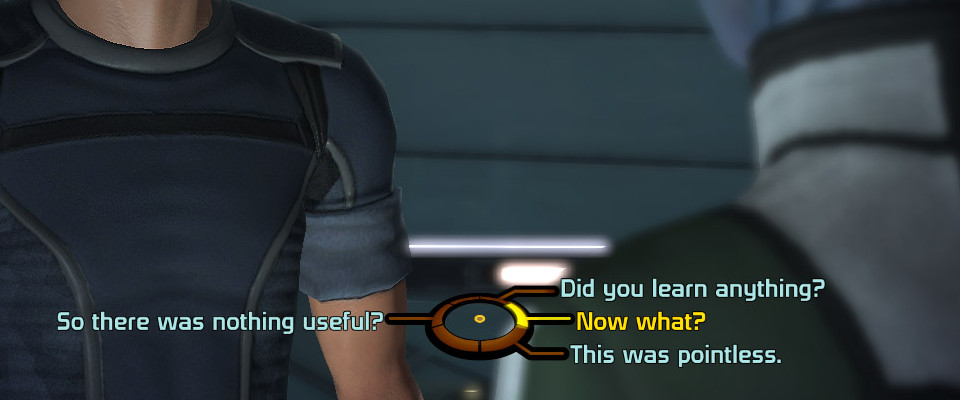
The Mass Effect series saw me continue to follow my wholesome approach to the nth degree, and even I labelled my own newfound genre of ‘intergalactic busy-bodying’. It was here that moral systems took a more obvious line of challenging you to make a choice, where there was no wholly good option to be had. The consequences of your actions ultimately becoming more realistic rather than purely dichotic. Largely though, that Paragon meter still continued to build, whilst the sliver of Renegade points sat as a glaring admission that I’d failed somebody. Probably myself.
The fundamental reward of extra conversation options based on your personal extremes in Mass Effect plays to those who favour one sole path anyway, and perhaps it highlights the difficulty in presenting a genuinely organic, free-thinking response to what you experience in any game. The fact that people will almost certainly gravitate to one side makes developers jobs easier, even when dangling an ability-infused carrot.
The problem is, following the path of the righteous utterly ruins at least one whole franchise for me, Grand Theft Auto. I’ve tried playing it, repeatedly over the years, as talk of generational masterpieces fly around alongside 10/10 scores from various publications and sites. I know full well that a number of the entries are considered to be amongst the best games ever created, but the fact that it forces me to take brutal action, with generally no ‘good’ outcome beyond raising your profile as a criminal, or getting some equally loathsome character off your back, just does nothing for me. Friends talk about the fact that the plot is only a minimal part within a free-wheeling, fun-packed sandbox where you can mess about to your heart’s content, but I just can’t get past a world where there is no room for being a hero.
There is of course the question of violence, but then just as every knight that ever headed off on a crusade believed, the end somehow justifies the means. Mario doesn’t blink as he crushes a Goomba beneath his patent boots, nor does Link as he drives his blade through a Moblin, but then we know they’re unequivocally evil – though now I’m wondering whether I should have shed a tear for Mrs Moblin, and the three fatherless mini-Moblins at home. I’ve still never kicked a chicken.
Telltale’s Game Of Thrones has perhaps set me on the path to change though. In true Game Of Thrones fashion nearly every single option given to you has no good outcome, offering no way that you, or someone else, won’t end up on the wrong end of a pointy implement. It’s refreshingly cathartic to think it all through, opting for what you feel to be right, only to find there was no way you could actually win. It’s more realistic, more challenging, and admittedly more impactful on an emotional level.
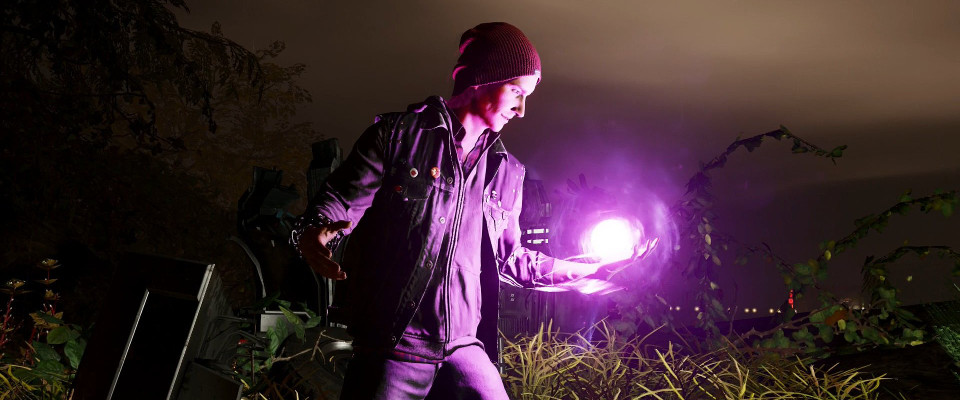
With the generational leap now well past we are starting to see some games challenge us further to consider the consequences of our actions, though I’ve so far still not felt genuinely pushed to stray from the light, especially when the morality systems in some games hasn’t remotely evolved as far as their graphics – Infamous: Second Son I’m looking at you. If more realistic ‘grey’ behaviour ultimately bestowed as many perks as the extremes, then playing as an actual person, rather than a one-dimensional hero or villain, might be more viable.
I know that either way I should take different approaches, simply if it means I can experience wholly new franchises, or as a way to challenge myself more on a personal level. Perhaps if Fallout 4 offers the option to eradicate a whole town I’ll consider it this time, you know, really think about it and maybe even, you know, press the button. Oh God… what have I become?
simplebob
I pretty much always follow the good path with the intention of playing the other side on the next playthrough and then never do. Something newer and shinier always comes along to distract me from the dark path.
Loving the Witcher in this regard. Even if you choose what you think is the “good” option, someone normally suffers because of it. Theres no fanfare, your armour doesn’t change colour and you don’t sprout horns, (virtual) life as a witcher just carries on.
hornet1990
Good article! I’m the same, I always play the first run as myself, which invariably ends up being the good guy. The second (usually max difficulty) playthrough is for the evil run, particularly in the Infamous series where it just made it easier to not care about casualties and generally exploit the game world to compensate for the harder difficulty (leaching civilians, blowing up cars etc). I do though have a bit of a cruel and twisted sense of humor which makes it easier.
Having said that I think my first encounter with a moral system was Fallout 3, and on the playthroughs to get the neutral and evil trophies I actually struggled quite a bit. Although I could be evil, I’d often absentmindedly start doing good and the level indicator would creep up instead of down, leading to having to go on rampages just to bring it back down.
Felt really bad when I nuked Megaton too. Yet strangely wasn’t moved one way or the other in the MW2 No Russian level :/
Only just started playing the Witcher 3 so I’ve not yet experienced any of its no-win choices, but I’ll have to check out Game of Thrones – sounds quite interesting!
gernboes
I haven’t read the whole article yet, so if im just repeating stuff, im sorry!
I’m pretty much the same, i almost always take the hero route and also to the extreme, even if personally i would make some decisions that would be more in the middle or on thr bad side. The reason for this, for me at least, is that almost all games with moral systems have rewards sitting at the two extreme points of the scale. You gain nothing for staying neutral or decide different from time to time.
Sometimes i repeat the story as tge bad guy, but only if the game is really good, or i need it for the platinum…
bunimomike
Finally, Dom has been corrupted. About time! :-)
Avenger
I really enjoyed Knights of the Old Republic 2 for its light\dark side system. Going fully to one side would reap benefits, bit even better was how characters would respond differently. New conversations would be opened, they felt unpredictable, and ultimately it led to big choices being made, characters leaving, and a split ending.
Unfortunately no Bioware game to date has been quite so in depth, although DA:O came close. It was comfortable to go dark side of the force, but I could never quite do the blood magic and evil of Dragon Age.
Overall, I do pine for a return of in depth choice and relationship in games. Maybe it’s just me, but it seems to have been glossed over too much in games recently, with things being far too simple and straightforward in decisions and conversations.