

Though they’ve had great success with games that rejuvenate the city building genre or star carefree wizards, Paradox Interactive built themselves up on a diet of historical grand strategy games. Whether it was taking care of your royal dynasty during the middle ages in Crusader Kings or waging the Second World War in Hearts of Iron, their games have always looked to the past for inspiration. Stellaris throws off the shackles of history and looks to the future and the burgeoning exploration of space.
Underpinning this are a number of familiar ideas and concepts from other PDS games. It takes place in pause-able real time with planets to develop, production queues to manage, ships and fleets to design and so forth, but where you might have sent explorers out to chart the New World in Europa Universalis, here you’re putting scientists on space ships and sending them off to visit nearby stars. They’re the new adventurers, and the impetus behind your young space empire’s evolution.
Unlike other Paradox games, you’re not starting off with an established nation within a historical context, and neither are your rivals for galactic domination. You all start off with a single planet orbiting a star, somewhere in the galaxy, and have to explore, colonise and harvest resources from otherwise uninhabited planets and star systems nearby. There are no established borders to contend with during the early stages of the game.
One interesting aspect is how you travel from one star and one planet to the next. Depending on your technology, you’ll be able to travel in a direct line from one place to another with warp engines, but this is slow and will have various downsides compared to the hyperlanes through which you can travel. Then there is the possibility of wormholes, for near instantaneous jumps from one place to the next.
However, you will eventually bump into other alien races, but again, these encounters will be unlike those of other PDS games, as the race’s look, behaviour, technology and more are all drawn at random, and they all start with just a single planet, like yourself. You might come across a race of cold blooded lizards in two consecutive games, but they might be peaceful in one and warlike in another, having living ships or metallic monstrosities. There will also be a number of stagnating empires out there, with particularly advanced technology, but little desire to keep expanding, for one reason or another. You never quite know what to expect.
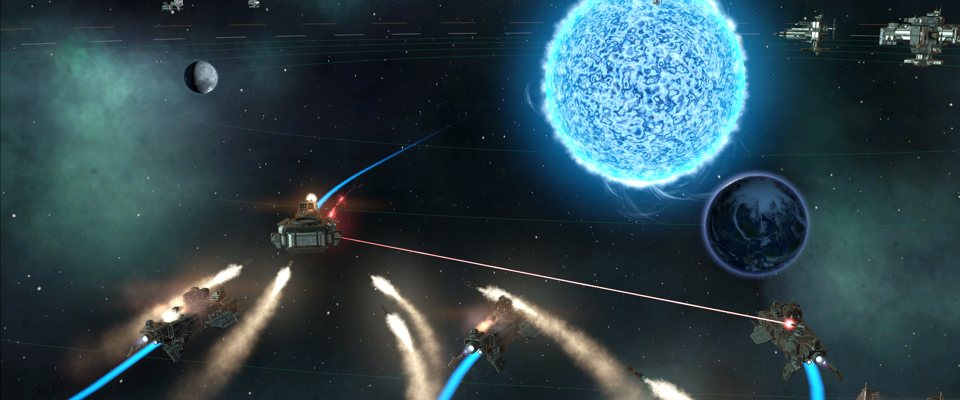
They could, of course, be friendly aliens, and potential allies who might eventually join a federation of empires, but there’s always the chance of hostilities breaking out. Your fleets will be a precious resource that can take quite some time to build up, so combat is something to be engaged in wisely, but it’s now also something that you can zoom in and watch in detail. You won’t have direct control, but you’ll be able to see the kinds of weaponry that your opponents are using and, once the battle is over, be able to send in one of your many scientists to scan and analyse the wreckage to discover more about the technology in use.
They really are key to how your empire and its technology evolves. There’s no predefined tech tree to head down, but rather, the opportunities you have for advancement depend upon the scientists you have and how they evolve, giving you a handful of avenues of research to head down. Sending them off into space gives them the opportunity to encounter new and interesting things, investigating asteroids and – so long as they don’t suffer a catastrophic research failure and knock the asteroid into a collision course with a planet, or something similar – uncovering ancient mysteries that can lead to branching exploration. This could result in discovering story arcs that reveal the history of the galaxy, shape a scientist’s development and open up new fields of science to investigate. They’ll start to pick up certain traits as well, with the most appealing by far being the mad scientist trait.
Take a mad scientist out of their space ship and put them in charge of your research programme, and you could end up with some exceedingly powerful and unusual tech. On the other hand, they could end up being the catalyst for one of the randomised galactic events, which are designed to shake up the traditionally dull and drawn out ending of a 4X game. Discovering how to manipulate wormholes could start to tear the fabric of space apart, sending your ships into another dimension entirely, your robots could gain sentience and turn on the biological races, or aliens from another galaxy entirely could invade, forcing you to simply try and survive, rather than conquer.

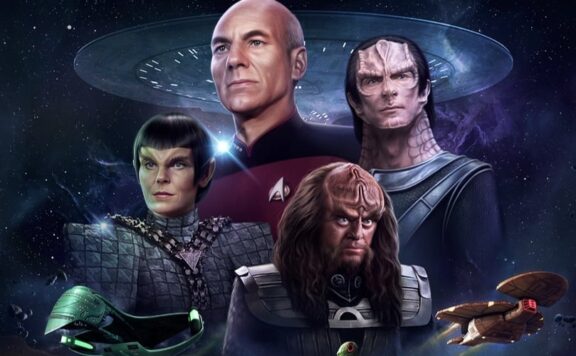
Of course, you can see the allusions to popular science fiction in some of those ideas, from Cylons to Tyranids, and there will be extensive mod support in Stellaris that should enable the community to bend the game to their desires. Just as there is a Game of Thrones mod for Crusader Kings 2, I’m sure it won’t take long after launch for someone to throw out the symmetrical start system, create Klingons, Vulcans, Romulans and all the other races and empires that make up the Star Trek universe – I basically just want to be able to play out the Dominion War from Deep Space Nine.
But even without a Star Trek or Warhammer 40K mod, Stellaris is a fascinating twist on Paradox’s traditional grand strategy games. From the futuristic setting in outer space to the numerous possibilities for how it can play out over the course of a campaign, which will make every game different, it feels refreshing and exciting to be able to venture out into the unknown.



beeje13
Those Galactic random events seem really cool and I’m a little surprised they impact on such a huge scale.
The game itself seems like a strategy version of no man’s sky.
Stefan L
Well… it’s not procedurally generated, but rather drawing from a large pool of human created elements, but I can see where you’re coming from. :)
bunimomike
PDS?
Carrot381
Paradox Development Studios?
Stefan L
Yes.