

Though the current crop of consoles might far be approaching their second birthday, new generations such as these mark the perfect opportunity for developers and publishers to roll the dice and try to establish a new IP with fresh ideas, a fresh setting and fresh potential.
Randy Varnell, Creative Director of Battleborn at Gearbox, sat down with us to chat about the game. First on the agenda was, of course, the name…
TSA: First impressions are a big deal with videogames, and it kind of feels like you’ve got an uphill struggle just with the game’s name, Battleborn. There’s a lot of games with ‘battle’ or ‘born’ in the title at the moment, and even then, it’s maybe not a title that pops out at you. What have you done to try and stand out from that crowd?
Randy Varnell: It’s kind of weird with names. Randy Pitchford actually does a lot with picking the names of the games, as well as working with our publisher, 2K. I think first impressions are important, but when you have a name and feeling of a game, it’s the whole [marketing] campaign that comes out in the end.
You know, when we named Borderlands for the first time, there were a lot of people going like, “That’s a dumb name,” or, “There’s not even really a borderlands in the game, it should be called World of Pandora!” But I think Borderlands earned its name, and the title was good enough that people now associate Borderlands with something that’s cool and good.
With Battleborn, full disclosure, we picked out name before we knew about all the other games. I think it was within two or three weeks of us saying, “Yes! It’s Battleborn!” and then the next week Battlecry announced and Bloodborne announced. Literally all our words in other names, but at the end of the day, our goal is just to make an awesome game that, years down the road when you talk Battleborn, our game is what you’ll remember.
TSA: The other thing you’ve really got to contend with, as you said in the presentation earlier, is explaining all of the different elements of the game.
Randy: I know, there’s a lot of stuff in there!
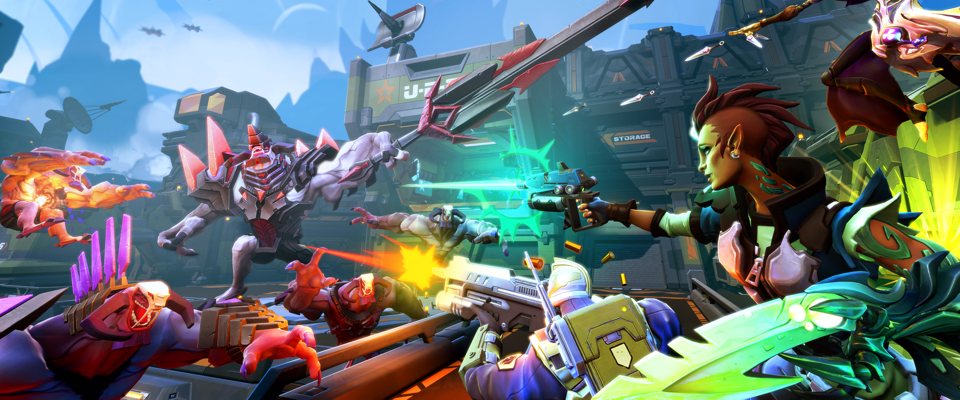
I always come back to the characters. There’s so many things to do, but the characters really are the beating heart of the game. Characters were really, really important to Borderlands as well, but this game even more than Borderlands.
Borderlands found its awesomeness and its variety really in the gunplay. It had a good story, it had a good mission and all these great supporting elements, but the procedural guns and the loot was what really kept you coming back. For Battleborn, we’ve moved that love and that attention to making a broad cast of characters and really going deep to create that variety there.
TSA: Yeah, you can feel that you’ve taken a few pages out of the MOBA playbook in that regard, so these characters, they’ve all got very, very different skill sets. Was that a key inspiration for you? It’s clearly in the mixture of what you’ve got there.
Randy: Sure. When I describe it, I always use these food analogies and I talk about Battleborn as my stew. It has several different things and MOBAs are definitely a thing in that stew, but, you know, a lot of the things we looked at with MOBAs were things that came right out of Borderlands.
When you look at the growth and the rapid builds and variety, I was Design Producer on Borderlands 2 and worked heavily with the design team there, and we were really enjoying playing with the talent builds, which are big tree-like structures. We used to do a thing where, when we were testing the talent builds, we would test it, reset, test it, reset.
At the same time, yeah, we were playing a little bit of League and a little bit of DOTA internally, and started to see that they do the kind of RPG growth but have a mechanic for fast delivery. We played with that as developers, and while you can respec in Borderlands, what if you could just do that all the time? The MOBAs kind of shone a little light on where we could go, and we started with that and brought some of that in.
Really, when you want character variety and expression, they also bring in little NPC minions and big numbers of creeps, and that really accentuates characters with area of effect or melee. There’s definitely things that we took from that, and when you look at a competitor these days, there’s several different games that are big on playing great team-based competitive matches. That was another thing that we wanted.
So yeah, we took a lot of inspiration from a lot of that, and there’s some MOBA in there.
TSA: When you take these characters over to the competitive multiplayer side of things, one of the first things I noticed, having picked a melee character, was that there was a guy on the other team with wings and with a gun. I simply couldn’t get to him. How do you balance for that divide in character styles, so that everyone’s still having fun?
Randy: The really hard thing with that, and you already illustrated it really well, is maintaining what’s special and awesome and unique about the character.
We discussed, like, “Does everybody need a pistol?” so that every melee character could have some ranged attack that they can always use. But then they’re not really just a melee character anymore and everything ends up in a hybrid mushy middle. We’ve tried to keep the character uniqueness and the gameplay expressions unique as well, but there’s some tricks that we’ve done.
There’s a couple solutions to that mismatch. One is that it’s a team-based game, so if you’re really having trouble with a flying character and you’re a melee character, maybe you shouldn’t be fighting that character? It’s like, “Teammate, hey. You shoot the flying guy, while I go hit the mushroom in the head a few times.”
We’ve done some things in the story missions to compensate for that as well. One of the things you could notice today playing through The Algorithm is that in certain areas you can build little flying drones. Drones are really great if you’re a melee character and need to deal with flying characters, the drones will actually prioritise flying enemies.
And all the flying enemies, they’ll always swoop down as part of their cycle as well, so even when you’re playing co-operative play, we give you some opportunities if you’re playing a melee character, to make it interesting. You may have to watch, you may have to adjust your playstyle to compensate a little bit…
But yeah, it’s complex. There’s not one solution, there are dozens of little solutions that we have to make all the way through the game to make sure there’s always a viable path for any character that you choose.
TSA: What are you trying to do with the story mode? People coming from Borderlands are presumably going to have a lot of touchstones in how it all hangs together?
Randy: Story’s really important to us. We really dug deep with story on Borderlands 2, and it was one of the major things we really wanted to improve.
TSA: Yeah, that was one of the key things that people highlighted as a big improvement over the first one.
Randy: Right, and there’s a few things that go along with that. Finding that tone and humour is important – Battleborn, even with serious end of the universe stakes, we’re bringing back that entertainment and humour.
One of the things we’ve done new is there’s a lot more dialogue that’s variable based on conditions. There’s big chunks of dialogue even in story missions that will change out if you bring different Battleborn in there. They all have their different place and origin points within the universe, so they’ll have different dialogue that they’ll say to each other, and even the story host, Kleese or other ones, they’ll change their dialogue depending on what character you bring, so there’s a lot of variety in there, even if you end up playing the same mission multiple times.
There is a beginning, middle and an end to the story that we have now, big villains are important – we highlighted Rendain here, who has his own eccentricities. We loved Handsome Jack in Borderlands and we wanted make a villain that wasn’t the same, but had that level of personality and that interaction with the characters too.
TSA: Yeah, you can tell in that trailer that we was kind getting a bit frustrated at the resistance to him and his own ability to express what he wanted to say.
Randy: He’s an interesting guy, because he looks like evil incarnate, but I think when you get to meet Rendain and spend more time with him, you realise he’s kind of a dictator and kind of a tyrant, but he really is trying to see to the needs of his people. He’s trying to make the right decisions for them.
He’s not a completely ruthless and selfish guy, but he looks so evil that everybody always think that everything he does is horrible, so he has to deal with people always cowering in fear. He gets frustrated at that sometimes, and in this one he smacks the camera and goes, “Where was I? Oh yes, you will die!”
Our writer Aaron Linde would say that the worst kind of villain you can have is just the Turbo Hitler, who’s just evil for evil’s sake. So we want some relateability and some understandability, and I think you’ll see that come out in the campaign.
Thanks to Randy for chatting with us about Battleborn. Be sure to check out our written preview from last night, if it’s tickled your fancy, and we also have a look at the game in action with Kris and Stefan discussing many of its aspects later today.
Lieutenant Fatman
I’d be very careful about taking anything these guys say at face value.