
It’s safe to say that the release of Battlefield 1 caused a rumbling of consternation and a bubbling of moralising within the historical community. This unquiet was framed around the question ‘is it morally right to create a videogame, which is designed for entertainment, to be themed around a horrific and brutal war in which 16 million people died?’. This question is made even more challenging when, after a brief play of Battlefield 1, the following statement was realised: ‘This game is really, really fun’.
For those not in the know, Battlefield 1 is a Campaign based FPS with an online multiplayer component. For those not in the know, that above statement probably makes no sense. For those of you in the know, you don’t need to know what those not in the know don’t know, as you already know it. Glad I could clear that up.
Anyway, despite the attempts of the developer, DICE, to add some moral depth to the frenetic campaign mode, this morally dubious nature remains. The developer’s attempts to lessen this can be seen most notably in the opening segment of the campaign, during which the gamer is thrust into the frontline. The player takes on the role of multiple soldiers within the Harlem Hellfighters (the very first African American regiment to serve with the American Expeditionary Forces during World War 1) who are defending their position against a desperate German assault.
To show the futility of war and how precarious the precious life of a soldier was in 1918, each virtual avatar the player occupies is ultimately killed, their name and birthday/deathday (the latter isn’t nearly as fun to celebrate) displayed forlornly on the screen as a reminder of those who lost their lives in the conflict. Unlike every videogame ever, there is no instant respawn. When your character dies they are dead. That is until you continue the game or play online, in which case you can be shot, impaled, run over by a tank, choked on poisonous gas, chopped in half by a sabre, bashed over the head by a shovel or incinerated in a flaming ball of death as your biplane is obliterated because your stupid pilot can’t avoid a very big hill, and you can still respawn to give it another go in approximately 30 seconds. Once more, virtual death is nothing more than a meaningless inconvenience.
If you’re still reading (and after such a long and ponderous introduction there’s every chance you’ve gone to glare at some drying paint to better spend your time) then you may be surprised to learn that, as a historian, I thoroughly enjoyed Battlefield 1. Not so much the campaign mode (that was basic, over far too soon and rather forgettable) instead it’s the compelling online mode that keeps me coming back for more. An expansion pack has already been released that adds new armies, battlegrounds and weaponry to the game. Yet I can’t help feeling that Dice are missing an opportunity by not including some of the truly weird and bizarre weaponry that was developed from 1914 to 1918. ‘What weird weaponry and items should be added and how would it be incorporated into the game mechanics?’ I hear you ask from the future when you read this (aren’t we clever being able to break the time space continuum)? Glad you asked because here are 5 weird but historically true weapons and items that should be added to Battlefield 1.
Brewster Body Armour
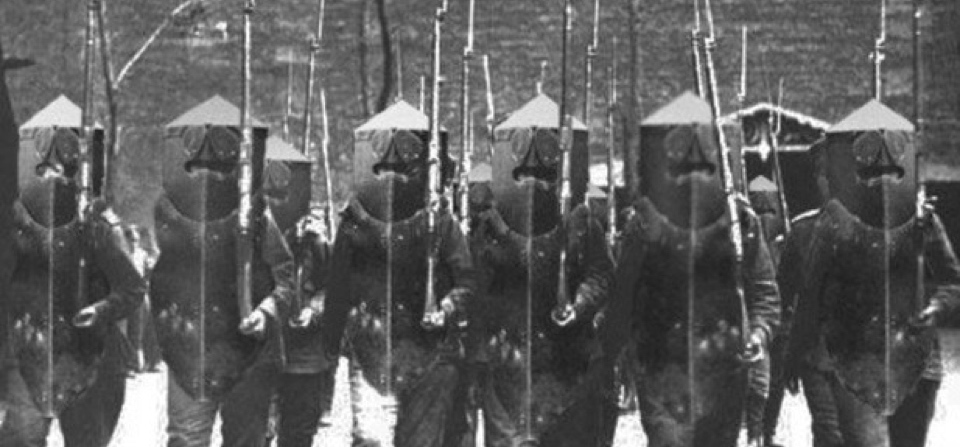
The invention of Dr Guy Brewster; the Brewster body armour was intended to save lives on the front line. Consisting of a large iron helmet with a post-box styled slot for the soldier within to peek out of and a large metallic breastplate to protect all the delicate organs within a frail human body. The armour could even withstand bullets shot from a Lewis machine gun (Dr Brewster tested this himself by donning the armour and having the American military shoot at him. Brewster described the experience as ‘one tenth the shock which he experienced when struck by a sledge-hammer.’ One has to wonder how he knew what it felt like to be hit by a sledge-hammer).
Now imagine the Brewster Body Armour as a pick-up item within the online game, similar to the support power up but much more potent, the armour would allow a player to absorb the kind of damage previously only possible within a tank. The only flaw would be that, just like the real-life version, the large, heavy helmet would prevent the occupant from turning their head. The player would have to turn their entire body to aim by using the left thumb stick, making them incredibly tough but offensively ineffective.

Poison Gas fans
The use of Poison gas in World War 1 was horrific. The use of Poison gas in Battlefield 1 is a minor inconvenience. None the less it can be mighty irritating when you find yourself in deep cover, able to headshot your enemy from half a map away, only for some pesky enemy soldier to lob a poison gas grenade and flush you out of your position. What about the inclusion then of poison gas fans? 104,000 of these waterproof canvas fans were issued to British Soldiers. During the war, many different countermeasures were developed to try and reduce the destructive loss of life caused by chlorine gas (and mustard gas too, to which no effective defence was discovered), from gas masks to cloths soaked in urine.
Within the game a gas mask is used (missed opportunity, a QTE minigame that sees the player having to aim their wee stream at a dangling hanky would surely be videogame gold). It can be quickly popped on, but it does obscure your vision and prevent the use of any scope. Not ideal. Instead have a member of your squad pull out a poison gas fan and with frantic presses of R2 they can gradually waft away any gas clinging to the air and allow you to continue sniping away to your heart’s content. As added incentive to use the fan, there could even be an additional trophy added for poison gas wafted!

Tsar Tank
There are many different tanks within Battlefield 1 but surely none as visually striking as the Russian designed and built Tsar tank. Tanks (or landships as they were initially titled) were originally developed as a means for troops to safely traverse the hazards of no man’s land and its deadly combination of trenches, barbed wire and people shooting thousands of bullets from machine guns. British engineers utilised caterpillar tracks to effectively achieve this goal, Russian engineers opted for giant bicycle wheels.
Like an iron clan penny farthing the Tsar tank had two giant spoked wheels (27 feet in diameter, measurement fans) attached to its armoured metal chassis. On paper, these wheels would have allowed the Tsar Tank to roll over everything in its path. Unfortunately, the ground of no man’s land consisted mostly of mud and very little paper, so the third and rather small stabilising wheel at the rear of the tanks became stuck in mud during the vehicles initial test run. The Tsar Tank could not be moved, the test run was scrapped and the vehicle remained in that muddy field until the end of the war.
That’s the history of the tank, and actually with the new Russian DLC you don’t have to imagine it in Battlefield 1 any more. A huge lumbering behemoth with an 8-metre high cannon capable of destroying anything in its path. The only downside in my eyes? At any moment, it could become stuck on a patch of mud. In my version of the game this would lead to the rest of the players having to work together to leverage the vehicle free, whilst also exposing themselves to a devastating counter attack.
Fake Tree
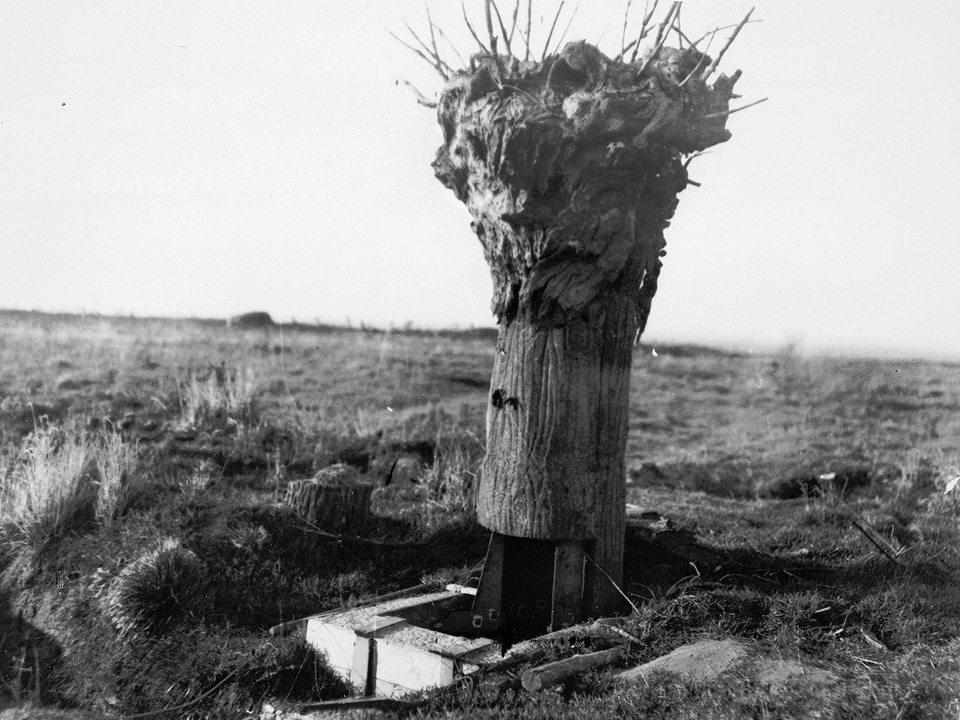
Life is hard being a sniper in Battlefield 1. You can spend 10 minutes slowly crawling, inch by careful inch, to find the optimum sniping position, only to have a biplane fly overhead and drop a grenade on your head. If only there was a way to camouflage yourself? There is if you use a fake tree! Its official title was an ‘Observation Post Tree’. Engineers would find a tree left standing on the battlefield and take extensive photos of it from every angle. These visual references would then be taken to the workshop where an exact replica of the tree would be constructed from hollow steel cylinders. These cylinders would contain internal scaffolding for reinforcement, to allow a sniper or observer to ascend within the structure once it was in position. Overnight the real tree would be removed and the fake tree put in its place. Come the morning a sniper would be perfectly concealed within this brand-new hunting blind, able to take head shots with absolute anonymity.
Now clearly this process would have to be shortened to work within the game mechanics of Battlefield 1. But if it were, having a portable tree to utilise as camouflage would allow snipers to rapidly change the dynamics of any battle. It would also massively increase tree fatalities in Battlefield 1, as paranoid players indiscriminately blow apart every shrub they find with a hail of bullets, just in case a sneaky sniper lurks within.

‘Flechette’ Aerial Dart
When biplanes were invented and initially used above the battlefields of WW1 it was done so purely for observation and reconnaissance. Then some bright spark had the idea of throwing stuff out of the plane onto the unwitting ranks of the enemy below. Starting off with hand thrown grenades and ultimately developing to mechanically delivered bombs. During this refinement process, it’s important to remember that a few other ideas and a variety of objects were flung from planes. Flechettes, French for little arrow or dart, were well named by the French as they did indeed resemble little arrows or darts. Or perhaps deadly iron pencils.
Their small size allowed hundreds of them to be dropped on infantry and cavalry positions by canny biplane pilots. Poison could even be added to the tips for an extra unpleasant surprise. Why should aerial darts be used in the game? Well, this is my personal request to Dice to end my article with. I’ll admit it. I’ll come clean. I’m a terrible pilot. In fact, I’m sure I’ve never racked up any kills by dropping bombs. Ever. But, by being able to drop literally hundreds of Flechettes, my chances of being able to hit some players is radically increased. At least before I accidentally crash my plane into a hill and thoroughly upset my co-pilot. People get really cross when that happens.




tonyyeb
I’m not sure a fake tree would make you safe, especially with the number of real trees and tree stumps that I regularly take pot shots at thinking they are enemies.
double-o-dave
Agreed – I’m pretty sure if I was in the fake tree, a random thrown grenade would land on me within 5 seconds knowing my luck. Or get ran over by a tank… or a plane land on me. I’d probably stick out like a sore thumb too on the desert maps.
tonyyeb
Yeah, they are like the Robocops of WWI. I think I’d die of gas, always somehow die because of gas.
double-o-dave
9/10 times, I swear on my god dam life I push the D-pad ‘up’ button to put my mask on, and without fail, my character either grabs a grenade or decides to lay down instead, then decides to do squat jumps or something stupid when I repeatedly tap the button in a panic just before my inevitable death.
Sort it out Dice! The servers keep quitting during a game lately as well.
tonyyeb
Oh I hear you! I have the opposite problem though, my gas mask comes on by itself and then my character goes through the ritual of taking it off, then putting it back on again immediately! Then I die.
Ade
Though surely more safe than hiding in a building? The amount of times I’ve been murdered by bits of falling masonry is too embarrassing to admit.
double-o-dave
No point in the Brewster Body Armour when you can just spawn in as Cavalry. Cavalry seem to be able to take more bloody bullets than a sentry!
Ade
I’m pretty sure that’s because they wear a single, solitary iron breastplate. It’s a well known fact that wearing the equivalent of a tea tray on your chest renders you invulnerable to a bullet from an SMLE Mark 3.
double-o-dave
…Or a rocket.
leeroye
“This unquiet was framed around the question ‘is it morally right to create a videogame, which is designed for entertainment, to be themed around a horrific and brutal war in which 16 million people died?’”
I dont see how this is different to the many games that have been made around WW2, or any other war for that matter.