
There was a post late in the week on TheSixthAxis illustrating that, once again, the supermarkets are scrambling for your cash as yet another high profile console game hits the straining shelves – this time it’s Electronic Arts’ FIFA 11, the annual update to one of the most successful series in gaming. I think the cheapest you could grab a copy without spending extra on lettuce and cling film was around £30, which is great, right?
Well, that’s not strictly true – the cheapest you can get FIFA 11 for is actually £2.99, on the iPhone.
And before those with Apple’s version start banging their keyboards in disgust, hear me out. FIFA’s a great game, always has been, but it doesn’t need to be played on a huge television to be a better game than it is on a portable platform – in fact, size aside if you’re playing it on an iPhone 4 chances are you’re playing it at a higher resolution than a lot of gamers picking up the PS3 and Xbox 360 versions will be. Still, it’s the game that counts, right?
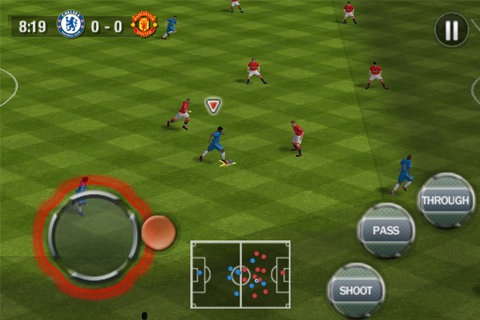
Interestingly, the iPhone version of FIFA 11 is actually rather good. The ‘floating thumbstick’ does away with any issues regarding missed controls, the on-screen buttons display the move rather than the usual ambigious alphanumerics and it plays just fine, and I’m not talking fine as in ‘for an iPhone game’ – this is FIFA 11, on the move, for 10% of the price it is on the two main consoles. Sure, there’s no Manager mode, and multiplayer is ‘coming soon’, but that’s not the point.
The point is that gaming away from the PlayStations and Xboxes of the world is getting cheaper, but nobody seems to want to admit it.
There’s a certain price point on the iPhone platform where a purchase becomes a no-brainer, an impulse, and it’s 59p. That’s the lowest a game can be without being free of charge, and publishers and developers play a very tactical game with their pricing to attract attention: a previously £1.19 game can suddenly garner a fair amount of extra sales by dropping to 59p for a few days, thus climbing the ‘paid’ charts and being much more visible to those that don’t ever trawl deeper than the App Store’s highest level.
Despite this, so-called AAA titles from well known studios (such as the likes of EA, Ubisoft, Gameloft and Chillingo) will sell at higher prices. At the time of writing FIFA 11 is the third top selling game on the App Store, behind a new to the market reaction game and the evergreen Angry Birds, both of which are at that aforementioned sweet spot of 59p. However, sitting underneath the football sim are a set of EA games reduced in price: Need for Speed Underground, Tiger Woods and Madden.
All of the above EA titles are real, ‘proper’ games, and they’re selling for peanuts.
It’s this notion that’s starting to make me feel that full price ‘console’ games are locked into perpetually being overpriced, and in danger of losing favour as these mobile titles start selling in their millions. iPhone gaming is maturing, thanks in no small part to the centralised multiplayer achievement hub that is Game Center, and it’s clear that the larger publishers like those mentioned above are starting to take notice, and it’s paying off.
With smaller development teams comes lower costs and although Apple’s cut is still considerable, the ability for iPhone developers to patch in complete modes such as multiplayer for FIFA 11 (in addition to the frequent bolstering of new levels and bug fixes seen across the board) must be a godsend. Sure, it’s frustating having to download the whole game each update (and FIFA’s almost a gigabyte in size) but most successful iPhone games see regular updates from the developers.
And when they do, such updates are generally seen alongside fresh reviews and new sales, and possibly even a temporary reduction in price, something that retailer led shelf space can’t afford – the high street needs to pay for rent and staffing, something that’s built into App Store sales as a percentage, not a fixed value, something that’s even more frustrating when the majority of PSP downloads are offered at the same price as the store bought ones.
The next generation of consoles needs to take a serious look at the behemoth Apple have created with the App Store – the PSP 2 needs to start attracting developers now and Microsoft need to push their Indie games project to consumers in a much more organised and user friendly way. But most of all, publishers need to find ways to get those retail prices down, after all, FIFA 11 on the PS3 might be a bargain at £30 but I can get most of the App Store top 25 for that…
Rocket_345
Although i may buy this on my Ipod when i get it it will just be to pass the time away waiting for my bus or when ive got 10 – 15 minutes spare. Even if the games is good it will never be chosen over my PS3 version when i get it.
jimmy-google
No multiplayer is no sale when it comes to a football game. It might be coming soon but that may also come at an increased price. Fifa 10 only cost my about £10 on my pspgo and I use the same copy a several PSPs for multiplayer whcih is great value.
I’m also not prepared to play a football game where my hands cover part of the screen. You need every inch of the screen available to you to see where your players are and make the perfect pass.
If an iphone or itouch ever gets me to play games on it it’ll need actual buttons. I also manage to get fair more wifi time on a PSP than I’ve been able to on an iphone.