
To really understand the essence of the Professor Layton franchise, one must go right back to the beginning. Launched in Europe in 2008, ‘Professor Layton and the Curious Village’ was a story driven ‘point and click’ style puzzle game that was a smash hit due to some clever advertising aimed at a slightly older market. I remember walking into various game retailers to hear the same question being asked over and over again – “do you stock the game where you separate pigs with a line?” This was in reference to one of the puzzles shown in the TV advert – and it seems this little piggy helped Professor Layton sell out in shops around the UK. 2009 saw the release of ‘Professor Layton and Pandora’s Box’ – continuing the first games blend of strong narrative and excellent puzzles; it was well received by critics and gamers alike.
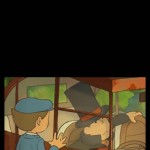
So this year sees the release of the third game in the franchise – ‘Professor Layton and the Unwound Future’ – is it a case of third time lucky? The game starts out with Professor Layton and his apprentice, Luke, receiving an impossible sounding letter from Luke ten years in the future. The message inside is troubling indeed – London of the future is in disarray and in desperate need of saving. As always things aren’t as they seem, and soon the story branches off, intertwines and eventually comes back together again. About six hours in and I was beginning to worry about Unwound Future’s story – it just hadn’t grabbed me in the same way that the previous games had and I was convinced I had sussed out the big plot twist. Needless to say I was wrong, and by the time the credits were rolling I had bore witness to the franchise’s most thrilling ending, with multiple revelations, twists and turns. It is also the saddest ending of the series, with details of the Professor’s past coming to light. The plot is stitched together by some wonderful Studio Ghibli inspired cutscenes and the voice acting – for the most part – is very good, and thank goodness Luke has lost his ‘cockney sparra’ accent from the previous games. Strike a light guvner!
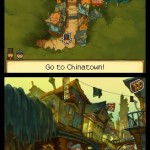
So now down to the meat of the game – the puzzles. Completing puzzles earn you ‘Picarats’ – and the harder the puzzle, the more Picarats you will receive. The scale starts at 10 Picarats (easy peasy) and ends up at 80 (tears, tantrums and harsh language). On the whole the puzzles are fantastic, and fans of the previous games will feel right at home. They range from observational puzzles, to mathematical brain twisters to downright sneaky word play – and they are all well explained. My only issue with the puzzles is the DS’s touch screen letting the side down. During puzzles where you need to twist and rotate objects, the touch screen just wasn’t responsive enough and instead of moving the required object, you would just end up spinning it in a circle – frustrating but in no means a game breaker. Puzzles are linked together by ‘point and click’ style gameplay – where the DS’s top screen acts as a map, whilst the bottom screen displays the area you are in. Every scene is filled with characters, puzzles and even hidden puzzles – and what may seem like a deserted area may in fact be full to bursting with information, it’s just a case of exploring with the stylus to find it.
As well as puzzles the game has several additional features to help pass the time. The ‘Toy Car’ mini game asks you to guide a toy car around a grid collecting items, which sounds easy until you realise you can only turn the car a limited number of times. Throughout the game you will earn stickers which are to be used in the ‘Picture Book’ mini game, where you must complete each sticker book by placing the various stickers in the correct location. The last mini game is ‘Parrot’ where you must guide your pet Parrot from one side of the map to the other – the only problem is the Parrot can only fly for a short period of time, so it’s up to you to draw perches where you think he will land. Much trickier than it sounds.
The negatives? Well they are few and far between. Sometimes the learning curve is a bit harsh – you will be cruising along solving 25 Picarat puzzles when you will be blown sideways by a 50. Thankfully the hint coins you uncover throughout your travels come in handy for that, as you can buy up to three hints per puzzle plus one ‘superhint’ which costs two hint coins instead of one. Sometimes I felt that the length of the game was being artificially padded out with the amount of needless backtracking going on. To traverse the entire map only to be told to go back to where you started gets old really quickly, and happens a bit too often.
Pros
- Looks fantastic
- Captivating, clever story
- Amazing puzzles
- At least ten hours long
- Thrilling conclusion
Cons
- Occasional difficulty spike
- A bit too much backtracking
- The story drags a bit in the middle
Professor Layton and the Unwound Future is one of my gaming high points for 2010. It is a charming, well constructed game that I had trouble putting down. If it wasn’t for the story lull in the middle, this game would be getting full marks. I simply can’t wait to see what Level 5 do with the Professor Layton 3DS game that’s on the cards.
Score: 9/10



Images taken from Gamepress. This is an import review – the game is listed for release in the UK on October 22nd titled ‘Professor Layton and the Lost Future.’



minerwilly
As a result of reading this i dug out the curious village last night and had a crack at it again . I got stuck a year or so back and gave up , i couldnt cheat and use the net . (this time i will though !)