
You want your freedom?
As journalists, bloggers, critics, it’s imperative that we have opinions. TheSixthAxis was formed on the ideology that such human traits – subjective thoughts and the ability to think for ourselves – was paramount, and such qualities persist as the site approaches its four year birthday.
Reviews, as a matter of course, offer perhaps the most freeform expression of one’s own findings – we’re at liberty to effectively write what we want as long as there’s a balance between what we see and experience with a certain, quantifiable amount of objective reasoning.
But isn’t, when distilled to first principles, any given game the same game for all? And if so, isn’t the latter part of the above equation moot and unnecessary? Does a review need to inform the reader that the multiplayer mode features mode X or that famous actor Y did three lines in the script?
Of course not – these things are trivial: mere statistics – but many do.
But more importantly they are constants, unwavering data that pepper each and every pressing of the disk, every digital download. In essence, they, and everything else that remains the same for every individual, don’t matter. They don’t need weaving into a critique, they want listing on the back of the box. In some cases, they already are.
And by the same token, appreciating a game on its own merits is equally crucial. When you play a game, if you’re subconsciously comparing one aspect, one feature, one bulletpoint with another then you’re not in the game, and you’re drifting. This is especially relevant and accordant to the concept of reviewing a game – it’s that game you’re talking about: not another.
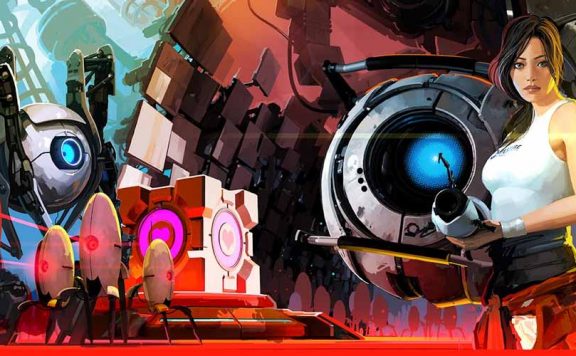
[drop]Where’s this going? Portal 2, and, specifically, our review. Even more specifically, my review.Blogs, news stories – they come and go, their transient nature today’s talking point but yesterday’s archives, but reviews linger, arbitrary, sole scores become encased in meta rankings stripped away from the thousand words preceeding and forged into some kind of all seeing, all knowing super score that determines whether developers get paid a bonus. Or paid at all.
It’s so deliciously easy to review a game. Even casting aside the rather personal notion discussed above – that anything that’s not at least partly subjective is effectively redundant – drawing up a blog and firing out a digit from zero to ten hardly constitutes rocket science. And it’s not like I’m not happy with the review on some levels, it was a real effort to keep it spoiler free for example but, and there’s a leap of faith here, by doing so I’ve completely missed the point.
Reading it back now is a depressing act.
It’s evident that as a hundred websites all scramble for the same air, we all end up regurgitating the same shit – and quite why I thought it proper to churlishly ramble on about black and white facts rather than how I actually felt about the experience (and it is an experience) doesn’t make for a terribly engaging review.
What am I actually reviewing here? Valve’s ability to continue a story? The fact that Portal 2 is better than Portal? That there’s elements of student game Tag spliced into the game’s middle act?
Self critique is a dangerous street, but here, when writing about one of the most brilliant games of this generation, that review reads like I’m marking homework. There’s no emotion, no attachment and no discussion other than faint, ambigious praise in case I say something that someone will call out as a spoiler, pandering softly to a reader I’ve never met.
Is the criticism of a barbed, thoughtless comment that might never appear more valuable or hurtful than my own? All too frequently here at TheSixthAxis we put others before ourselves, internal debate and a hasty edit button a reaction to an action that might never happen.
And because of that, I hate that review. Portal 2 deserves interpretation, it warrants looking beneath the surface and pulling apart rather than skimming over the surface. Spoilers or not, there’s so much to talk about that I’m still, weeks on, literally bursting at the seams and wanting to spill to anyone unfortunate enough to be nearby.
It’s not a pleasant sight, and probably wouldn’t be great reading, but I’d be happy in myself.
So as I commit this blog to the vast well marked ‘Pending’, not knowing whether or not it’ll ever see the light of day, at least I’ve tried to make peace with myself: my score of 9 wasn’t correct, and whilst a score’s just a score, it was the wrong one.
Portal 2 is, perhaps, the best game I’ve ever played – and irrespective of all else – there’s no higher praise I can offer than an apology.
Goodbye my only friend.
Samiro05
What’s portal?
teflon
How could you give it a proper review score without the looming threat of death? :)
TSBonyman
While I respect anyone who might accept they were wrong about something I wouldn’t like it to become a regular thing where reviews are re-evaluated.
bunimomike
To be honest, matey, I personally reckon that our pre-conceived notions (and even early experience) is usually incorrect when we’ve had time to truly digest a game.
At best, most of the game industry is struggling to get all of the reviews out in a) a timely fashion and b) with the correct amount of time applied to said title so a fairly accurate opinion can be formed.
I went into Red Faction with a “this is definitely an 8 out of 10 game” and to be honest my final score is somewhere around the eight mark but what’s hard to quantify is that the entertainment I’ve had from it is through the roof.
I guess what we have is the technical difference between nailing things down to a review; to a handful of paragraphs; to a number – whereas the unquantifiable feeling is simply impossible to truly clarify. So many times we tell our peers to “give it a go and see what you think” as we wrestle with imparting our true emotions about any given game.
Funnily enough, I’d quite like to see more retrospective reviews but realise it might undo the very nature of initial reviews at launch. Meh, I’m never happy. :-)
TSBonyman
Good points Mike and i like the Weview feature, i just think we could start revisiting a lot of games, altering their score and things would get a bit messy.
teflon
He’s not changed his review score. This is like Edge magazine saying a few years back that if there was one review score they regret it’s that they didn’t give Goldeneye on N64 a 10 instead of a 9. This is Nofi just saying that having devoted more time to the game, and soaked it in a bit more, he wouldn’t have given it a 9… It doesn’t change the review itself, it’s just a touch of hindsight.
TSBonyman
You’re right – I don’t know why I put the word score there, my bad.
Basically I read it as Alex not being happy with his original review and wanting to change it. That’s ok, I do understand what a difficult task it can be to review games but also I think a review should be signed off when finalised and left as is.
I guess these days, especially with the likes of GT5 which arrived essentially unfinished, and due to the ubiquitous dlc which now follows after most games, the landscape for reviews may be changing.
Anyway, my original point is probably moot as I don’t expect my ‘fears’ will be realised on TSA. :)
3shirts
You know, a lot of people get too worked up about the very concept of spoilers. Not all spoilers are equal.
I don’t mind someone giving away the odd story element or joke, I really only consider something a spoiler if it spoils the whole piece. The Sixth Sense or Fight Club twists are proper spoilers, they would genuinely rob a viewer of the intended experience of watching the film. Someone saying the cake is lie or laughing about a companion cube before I’d played the first Portal would confuse me but when I finally played it, I’d just think ‘oh I see’ and carry on.
It’s about perspective.
Voganlight
I think that in the case of Portal 2, you should avoid the spoilers; it’s the story that makes the game just so much better.
3shirts
Don’t mean to sound petulant but did you actually read my comment?
I haven’t played Portal 2 yet but I fail to believe that someone mentioning the odd part of the plot/gameplay/humour would ‘spoil’ it for me when I do. Sure, don’t tell me what happens in the end or any of the twist or key elements but walking on eggshells afraid to mention anything in the game is silly and doesn’t help either of us.
Voganlight
I did. What I’m trying to say is that Portal 2 is so brilliant even the trailer with its 4 quotes or so slightly ruined those moments for me in the full game. It’s not about the overarching story, it’s about the little remarks that come out of nowhere for me.
JoshHood
The first five minutes of the game are spoilers, and mentioning any particular part of the game would spoil what comes before it due to the way Portal 2 is structured. It’s just that sort of game.
kevatron400
We forgive you Al, what matters is that you got across the point that you loved it (to me at least).
online4ntagonist
Don’t be so hard on yourself. I thought you did a great job and I think everybody on here reading is clever enough to look deeper into the game and appreciate it’s value. If not, then so be it. No one can ever please everyone at the same time.
I confess I do feel what you’re getting at with this, the feelings of regret for not rating it with a ten must be excruciating! :D
BioEye
Anyone looking for a review without some form of spoiler (even if it’s minor) shouldn’t be looking for a review. Reviews will have to talk about the game that they’re about, and if the reader wants to keep that experience for a first-hand experience, they’ll know that a review is going to have info about the game.
DrNate86
I disagree. You read reviews to decide if you want a game, not to discuss it afterwards. Including spoilers negates the whole purpose of a review.
Voganlight
Agreed. Reviews should focus on the reviewer’s feelings about the game more than how the game plays out, etc.
DrNate86
Just to expand that point, I mean spoilers relating to anything not contained within the opening blurb of the game. Including or alluding to any big changes that occur after the initial set up of the story.
BioEye
Yeah, I didn’t mean major spoilers. Minor spoilers can be just little moments or quotes. If you don’t get some info, you’d have little to base your decision of buying the game on.
3shirts
I’m with you BioEye. If someone had told me Bruce Willis was dead in Sixth Sense before I saw it, I’d have been mega pissed but if they told me it was about a boy who can see dead people, that’s fine.
DrNate86
Bruce Willis was dead?!
DRCD1
It’s always such a pleasure
to see these retrospectives here in TSA.
cubehouse
Weird really, I don’t read many reviews now. I’ve usually made up my mind whether to buy a game or not from previews.
I usually read reviews after I’ve played a game because I like to see what the “professionals” thought of the game I had just played. It’s fun to see how my opinions match or differ from gaming journalists sometimes.
I completely agree with this article though.
BrainDiver
I’ve been finding the same thing lately, I have a pretty eclectic taste in games so I find that buying the game from my own gut feeling works best.
On another note, I really do like these retrospective pieces, nice one Nofi. I didn’t get this because I never played the first, but I really will pick up both the next time funds allow for some frivolous spending :)
Foxhound_Solid
Poison chalice soon.