
The humble triangle. It’s so utterly integral to gaming as we know it, and yet so often overlooked in favour of its more glamorous four cornered friends, the square and the rectangle, and even the cube. But in TRI, the triangle is king.
Possibly the most distinguishing feature about TRI is the ability to create triangles almost anywhere in the world. Played from a first person view, you simply look at the walls and place the three corners to create a triangle.
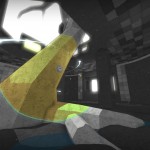
These can create platforms for you to walk on, helping you to reach higher places and ledges within a level, in order to explore and solve the puzzles. Importantly, they’re not infinitely flexible, and so there are limits to how you can use them. The triangles cannot be too large, with an area highlighted to show where it is exactly that you can place them, and you will also not be able to climb a triangle that is too steep, at which point it is coloured red and not yellow.
We spoke to Jana Reinhardt, half of the German duo that are Rat King, who revealed the origins of the game:
“Friedrich [Hanisch], our programmer, always takes part at Ludum Dare game jams, and just had the idea to make platforms. In 3D games, everything is made of triangles, so it just came up to let you build them in the game, not just as a designer but also to give it to the players.
“Friedrich tried that for 48 hours and players liked it, so we decided to make a whole game out of it.”
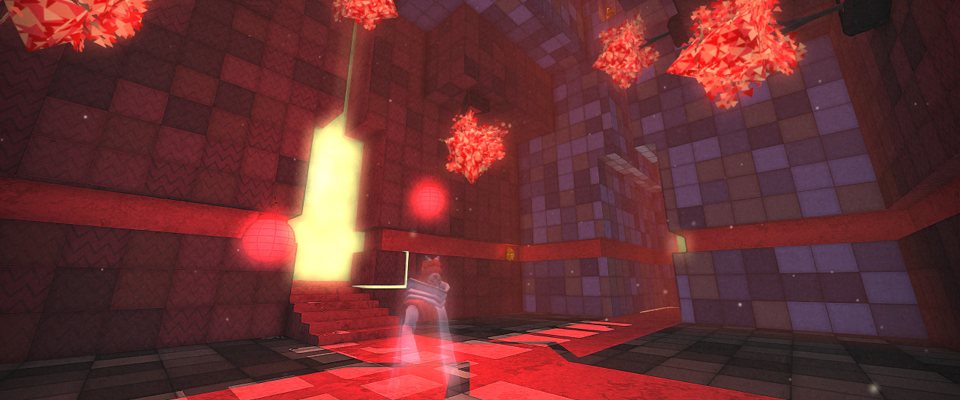
The challenge to the game is figuring out how to get to places and exploring the world. With the flexibility of being able to create those triangles practically anywhere you want, the level design is able to be quite spartan, giving you an otherwise insurmountable wall and trusting that the player can create their own path.
It means you will often have to find creative solutions to traversing the oft labyrinthine levels. Create triangles that rest upon each other and you can make yourself a path to practically anywhere.
Each level features a trio of fox-shaped keys, as well as a ton of collectibles, which are hidden away throughout the world and must be found in order to open a triangular portal to the next level. Thankfully, you are able to bring up an overlay to show you the locations of those statues through the walls. However, with exploration being another key factor in the game, there is no map for you to fall back on should you get lost.
Jana explained, “We had the longest discussion about if we wanted to show players, when you press F1, where the keys are. Even then, the exit is not shown. Before we used F1 for this, people had to find every key for themselves, and now you just have to press F1 and go somewhere in this direction.
“It’s always a balance. Do we want to make a hardcore game where people really have to remember everything, or do we want to help them a bit more?”
One solution for a player is to leave triangles as a kind of trail of breadcrumbs, and Jana added that “At one point, the Monk says, ‘Hey, did you know you can use triangles to remind yourself where you were?’ because not everyone thinks of that. It shows how different players are sometimes.”
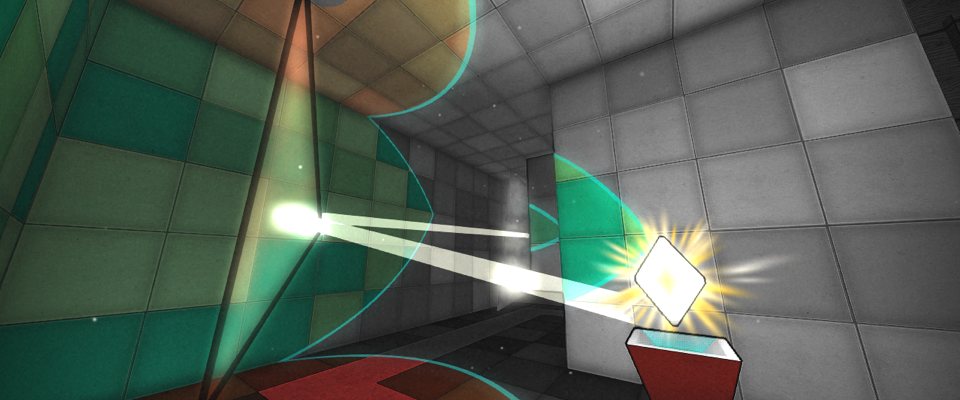
Quite quickly, the game starts to teach you new tricks. Triangles start to shift gravity as you walk on them, effectively letting you walk on walls and ceilings until you step off the triangles, as well as coming to reflect light and lasers and the game mechanics become more complex.
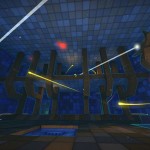
The levels themselves have a wonderful aesthetic, with bright and bold colours featured throughout. It might be deep reds in one level, pastels in another or jade greens elsewhere, but they’re bound together by a consistent style, even as the locations and ideas change.
Things quickly shift from a garden and temple to the progressively more abstract. A tower floating in the aether seems to be much bigger on the inside, trees grow out from walls, and there’s some great contrasts between tight and enclosed spaces and the vast expanses of the deeply coloured skies, all added to by a very atmospheric soundtrack.
It could all exist on its own merits, but it will be brought together by a story. As you play, a Monk acts as your guide in this world, nudging you in the right direction to explore and learn, but there are also numerous appearances of a Fox, almost taunting you with its presence before disappearing as you get close.
“The story is inspired by Japanese tales with animals,” said Jana. “It’s a story about two foxes that are gods and live in this world. One of them got interested in this triangle that just appeared, but this triangle was powered by evil and made the Fox go mad. The Monk, who is also a Fox, decided to close this world and build a temple so that nobody else gets mad from this triangle.
“Since then, the Monk has always seen his old friend, the Fox, in the mirror, but one day he didn’t appear, so the Monk sends you into this old world to find the Fox.
“The thing is with TRI is that you don’t really need a story. You can play the game without any story, but we love to make stories and we wanted to have that motivation for the player. The Fox sometimes appears in the level to show you’re in the right place and motivate you to go there.”
Although they’re speeding towards a final release some time this summer for PC, Mac and Linux, TRI passed through Steam Greenlight quite recently and has already been in beta for pre-orders on the likes of Desura and IndieGameStand. There’s also a slight chance that it could appear on Wii U, though it’s subject to experimenting to see if the gameplay and controls will adapt.
Out of the humble triangle, Rat King have created something quite unique. Within an attention grabbing and colourful world, the ability to create triangles is at the heart of an evolving and increasingly mind-bending puzzle game.
lambchop
Fingers crossed for a PS4 version.