
Alongside Mario, Nintendo’s other true behemoth is the Pokémon franchise. The continually expanding roster of pocket monsters features some of the most iconic character designs of the last twenty years, and while various members have appeared in the Smash Bros series, we’ve never seen them in a dedicated fighting game that truly draws on the lore, the world and its creatures. With Pokkén Tournament from Bandai Namco, players will finally get that chance.
You find yourself in the land of Ferrum, a huge island surrounded by nothing but the ocean, while Nia and her battle partner Weavile welcome you to Old Ferrun Town. Each town or city on the island serves a different function, with Old Ferrun Town acting as your home base where you can check battle data or change your settings.
Ferrum Stadium is the central singleplayer battle hub, and it’s here that the Ferrum League is held, with your sole purpose being to beat your rival trainers and their Pokémon in battle. You’ve also got Tellur Town which acts as a single match hub, Selen Island for local multiplayer, and Neos City for all of your online battling needs. The final spot on the map is reserved for Techna City, your practice centre, where you’ll learn the ropes of Pokkén and Ferrum Battles.
The game starts with you registering your avatar, and customising it in a few limited ways including gender, skin colour, and face type. After that you gain a Battle AR, a mic/headset of sorts which has a Synergy Stone built into it that allows you to synergise with your Pokémon in battle. In essence this means you take direct control of them, and the fun begins!

Your next step is to choose your battle partner, with the fourteen-strong opening roster including iconic creatures like Pikachu and Charizard alongside less obvious choices like Chandelure. I opted atypically for Pikachu, because I can’t resist the cheeky little electric mouse, though I was tempted by the somewhat cooler Lucario for at least a couple of moments. While the Wii U edition features six more combatants than the original arcade release once you’ve unlocked them all, it still feels a little barebones, given the huge roster of Pokémon in the RPGs, though it’s clear that they’ve put everything into making those characters look their absolute best.
Unsurprisingly, you move about the arena with the left analogue stick, while B jumps, Y unleashes a ranged attack and X performs a homing attack, with the A button reserved for Pokémon moves which differ from character to character.
All battles consist of the contrasting Duel Phase and Field Phase, and understanding when to use them seems key to your success. You can change to the Duel Phase by pressing up on the D-pad at the same time as the Y button, which triggers a particular move and makes your attacks more powerful, while also shifting your viewpoint to a more traditional 2D setup, before switching back to Field Phase with another special attack and hopefully rounding off a serious amount of damage to your opponent.
Luckily you can block attacks by holding down the R button, all the while biding your time to strike, and there’s also the Synergy Burst special move that you can unleash with the two shoulder buttons when the gauge is filled. Thankfully the tutorial also teaches you some basic tactics, with the game boasting an attack triangle that it pays to take to heart. Counter attacks beat normal attacks, grab attacks beat counter attacks and normal attacks beat grab attacks, with each attack type having a different coloured flash alongside to help you read your opponent’s moves – if you’re fast enough.
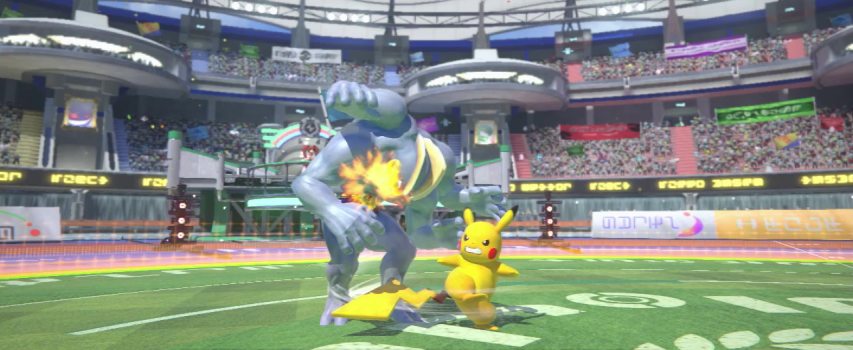
They’ve drawn on the mainline game in some ways for the combat system, not least of which are the positive and negative statuses that your character can come under the influence of. Calling on one of the 26 support Pokémon seems to be a good way to gain a positive effect such as a heightened attack, while negative ones like reduced defense can be the result of your opponent’s attacks, or an unwanted side-effect of some support moves.
The tutorial does a fairly good job of walking you through all of the controls and techniques, though it’s pretty overwhleming once it’s all done, so much so that younger children may have no idea what’s going on. There’s a surprising amount of depth to the combat system, and it’ll be interesting to see how players utilise the different abilities as they face off against each other, or whether the game will reward button mashing over a more considered approach. You can certainly have a healthy amount of fun just hitting all of the buttons, but I’m sure we’ll see a tendency toward higher level play in the long run.
No matter how you approach the game, the 3D renditions of the Pokémon are the best we’ve ever seen, and they’re also all provided with their authentic speech which makes them a joy to behold. Any Pokémon fan worth their salt will undoubtedly love to see Pikachu and his pals in action, and hopefully the gameplay itself will promote just as much joy when the game launches next month.
Kennykazey
The gameplay seems very unique for a fighting game. Perhaps not my cup of tea, but I definitely want to give it a go. If this game gains success then hopefully more Pokémon will join in as DLC in the future.
Perhaps a sequel on NX could have great potential?