
EA Play saw a big reveal for one of the grandest attempts to rejuvenate the FIFA series in quite some time. There are, of course, plenty of gameplay changes to add better AI, more physical play, overhaul set pieces and more, as you’d expect from any other year, but these come alongside a switch from Ignite to the Frostbite engine, and that’s been done in order for EA to add The Journey, a rare story mode in a sports game.
Be sure to check out our hands on preview from last week, but to try and get a handle on all of the changes being brought to the table, we also spoke with Aaron McHardy, the rather ebullient and affable Line Producer on FIFA 17.
TSA: The big new thing in FIFA 17 is with The Journey, but stories and sports games haven’t really gone hand in hand too well in the past, so why are you trying to add a story to FIFA?
Aaron McHardy: First of all, while it’s big and massive, I think that we should not forget gameplay, because that’s always at the core. [laughs]
TSA: [laughs] Yeah, OK, but The Journey is the big…
Aaron: The big shiny object in the room? Yeah.
But why why we embarked on the journey to create The Journey, we’ve done research and we know that a lot of our fans are motivated by a single player immersive experience. We knew that was a section of our game that we didn’t really cover off – a cinematic, narrative driven mode. We know that’s something that our fans want.
We’ve known that for some time, so in fact, we’ve been working on The Journey for two years, but the thing that really opened the door to us was the move to the Frostbite engine, because that gave us the ability technically to create all of that content at a pace fast enough to execute on it. I think without Frostbite, there’s no chance that we’d have been able to create enough content in the amount of time that we had, for a compelling cinematic story mode like The Journey, but now with that technology, we can.
I think that’s a big reason for why we actually took on the challenge, is because we knew that we could do that with the toolset that we were coming into, and we knew we could do it justice. A lot of the time over the years, people ask us, “Well why don’t you do this feature?” and the answer we give is that we don’t want to do it until we know we can do it and it’s good! That’s the short story here: we got this technology that allowed us to make something we know is good and we know that people want.
We felt like we could innovate in that space, and we’re proud of the quality bar that we’re able to show you here today.
TSA: Yeah, and obviously you can see that with the quality of the faces that you can see in this engine. As a quick tangent, what does this mean for the Ignite engine as a whole? Is Frostbite going to be adopted by EA Sports as a whole?
Aaron: It’s a good question, and I think the answer to that’s actually quite good too!
TSA: Well, now you’ve built it up! [laughs]
Aaron: We get the best of both, and that’s the beauty of us, specifically FIFA, moving to the Frostbite engine. Like we talked about in the presentation, it gives us a lot of things, where I talked about what it does for The Journey, and also with collaborating with the DICE guys where they could come in and help us get the most out of the tools that we have.
But the other piece of the picture that we haven’t talked much about is that we bring a lot to the Frostbite engine too. There’s a lot of technologies in the sports franchises, and specifically FIFA, that we’re now building into it.
TSA: So it’s both sides merging into one, almost?
Aaron: I wouldn’t go so far as that, because we are very much going onto the Frostbite engine, and it’s not like they’re colliding and meeting in the middle. We’re going to Frostbite, but we get to bring some of our friends along with us, and we’ve got technologies and tools that we can build into the Frostbite engine that will help everybody who’s using it. So that’s why it’s the best of both.
TSA: Turning back to The Journey, are you aiming for quite a serious drama? Or are you accepting that, you know, it could be a bit cheesy and silly?
Aaron: I’m not going to say we’re attempting to make a comedy or anything like that!
We try and shy away from cheese as much as possible on the FIFA franchise. Beauty is in the eye of the beholder, so one person’s cheese might not be another person’s cheese, so it’s hard for me to say unequivocally. What I can say is that we try to root everything in authenticity, and we’ve run the story, all its elements and all the dynamic content that we’re doing through credible people who have lived this life.
There’s the professional footballers we’ve included, like Dele Alli and Marcus Rashford, and the ambassadors to the game that we’ve brought on board, these guys have all vetted it and they’re there to tell us that it is authentic. We’ve had Tom Watt the sport journalist, to vet the story as well, so that we can say it’s authentic.
Generally, on FIFA, we try and err on the side of authentic when we decide on a direction to go, and I think The Journey is no different to that.
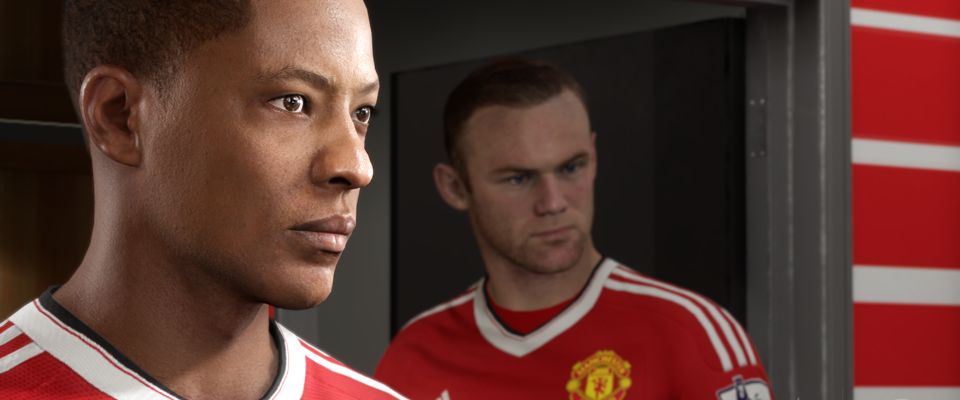
TSA: So that’s why Wayne Rooney was on the bench in the demo then? [laughs]
Aaron: [laughs] We were hoping nobody was going to spot that! That’s mid-cycle stuff that’s not meant to be brought up! You have a good eye though…
I think he’s on the pitch too, so that’s the real bug, but that’ll be addressed before we launch.
TSA: One of the things you’ve taken criticism for in the past is that features and changes at preview events are dialled back and balanced for launch, but some of the changes here – penalty run ups, physical play, low shots – these feel much more fundamental. Do you think that’s risky, that some of these are so different?
Aaron: It’s always risky to change a game from what people are comfortable with; it’s a hell of lot more risky to leave it the same, though. [laughs]
At the end of the day, we come out every single year and we have to offer a game that someone will say, “Yeah, that’s a really good new version of the game.” So we’ve got to take some of those risks, but the way we go about it is we try and manage that in a way where the transition is as smooth as it can be. […]
Looking at the physical play overhaul, a part of that – and it’s a small part – is reorganising some features we already have to work with that system. On the defensive side, we already had shoulder challenges, we had step ins, push pull, and all of these mechanics on different buttons. So really, what we wanted to do was make physical play be everywhere in FIFA and on demand with the press of a button. So we reorganised our controller set to do that, because it’s easier.
We’d found that shielding, on the attacking side, was something that very few people actually did because it was difficult. It wasn’t that it was difficult to comprehend, it’s just to press this button at this time, but in the flow of the game, it was difficult to do. […]
Now we’re able to step back with the physical play overhaul and say how can we make this more inviting? And how can we make it more like football? In realistic terms, when you watch the game on the weekends, there’s physicality everywhere. You can’t say it only happens when you’re standing still and there’s a guy directly behind you, which is kind of how shielding has worked in FIFA in the past.
So now we can introduce something new, which satisfies what I was talking about originally, which is changing the game, but we can introduce it in a way where it’s heavily based on context and it’s simple to use. So the game becomes cerebral about where I use it and when I use it, not how I use it. […]
Now I’d be lying if I didn’t say I’m not worried about how we’re changing all of our set pieces… [laughs]

TSA: Well that’s what I was going to lead to, because I’m not sure of the new set pieces and there’s a lot more changes. Penalties, you control the run up, free kicks, you don’t control the run up but the camera stays with you, corners have an icon for where you’re aiming…. It feels like you’re adding layers that mean you have to learn things all over again.
Aaron: Absolutely.
So there always is risk, and we do what we can with tutorials and ways to explain those things, but when we make changes like that, where you just have to change something, you weigh it up against whether the change is worth it.
TSA: I mean, I remember the last time you changed the penalties and the fallout you had from that!
Aaron: Yeah! But at the end of the day, we believed it was worth it and it meant that penalties became better because it went from rock-paper-scissors to something that had a lot more variety to it. We’re doing the same thing here, and especially with the corners.
We’ve created a whole new feeling for corners, and I feel like the elation and the satisfaction you get when you get on the end of a corner and put it in the goal is far superior to what you used to achieve in the old system. So that, to us, feels like it’s worth it.
The other thing we did with corners, we actually set them up so that, by and large, you can take them the same way as you did before. You didn’t realise it, but it’s not too dissimilar, you can just move the stick, power it up, so if you don’t want to bother learning right away, you can still be functional. That was an intentional decision that we made, but if you want to learn the new controls, you can go deeper, you can control the guy in the box to battle for position, you can do all sorts of things.
It’s the same for the penalties. It’s slightly different with the controls, where you’ve got to move toward the ball and power up to strike it, but it’s built so that it’s very similar to what you’re doing from free play, where you point to where you shoot and power it up. When you boil it down to that, it’s very simple, but then we layer on things that make it creative and new, like controlling your run up.

TSA: Finally, is there ever really any push back from FIFA? Obviously, you have to represent the sport in a positive light, and sometimes the sport isn’t that positive, so with the jostling and some of the more combative sides of the game, is some of that ever going too far?
Aaron: So, there’s points where FIFA guide us against, but usually they’re not the things you’re describing, they’re the things that are peripheral to the game that nobody really wants in the game.
If you’re talking about physical play, our intention is to create authenticity and make the players as physical as possible. The only thing that FIFA asks, and we would ask it of ourselves, is to make sure the official is doing his job as well, [laughs] and that he’s blowing the fouls for things that are crossing the line.
Thanks to Aaron for chatting to us about FIFA 17. Be sure to check our hands on preview from last week.





TSBonyman
W
TSBonyman
oops, fingers mashed the keyboard.. don’t know what i’m doing here in a football-related article .. o.O
Stefan L
Get to bed mate, you’re drunk. <3
TSBonyman
I wish.. quiet day at work.. ;)
Oh well, i must admit i’m a teensy bit more interested by the concept of a story-based football game.
Amphlett
There’s no gameplay footage in the “Gameplay” trailer, just pre-rendered video. :-(