
Between the game’s announcement and gameplay reveal, and the preview session I enjoyed around Gamescom, I’d seemingly completely forgotten just how big, broad and ambitious Tchia is. It’s a game that exceeded my expectations at almost every turn. More importantly, it’s a game with a real soul and utterly individualistic identity, and could be one of the standout indie games of 2023.
While it takes place on a fictional, nameless series island, Tchia is fundamentally and deeply rooted in the setting and culture of New Caledonia in the Pacific ocean. Every element, from the Drehu language that the characters speak, to the flora and fauna, and the mythology that provides the backbone of the game’s folklore-infused gameplay is drawn from this island. This includes recreating and modifying New Caledonian landmarks like Hienghène to fit into this game world.
These islands provide the open world that you can roam and explore however you wish, and this where the game is perhaps at its most magical. On the one hand our young heroine Tchia has a Breath of the Wild-like ability to climb up any surface you want, combined with the ability to go diving in the surrounding ocean, the sole limitation being a stamina bar that seems fairly forgiving, even at the early stage of game that we saw.
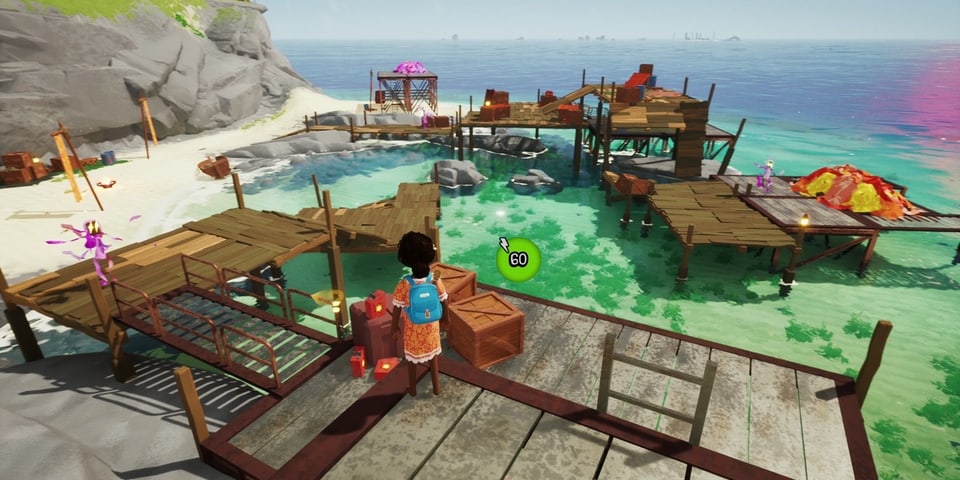
From that point, though, things get start to be more cartoonishly brilliant. Again, as in Breath of the Wild, Tchia can glide down from any height using a ragged looking patch of fabric, but more sensational is the way that she can climb up trees, make them sway back and forth before catapulting into the air. With flips and tricks that you can pull before gliding to the top of another tree, this looks like a wonderfully daft and freeform way of getting around the island.
That’s only the half of it, though. With a glowy green eye, Tchia can look at and possess pretty much anything on this island. Whether it’s a tyre, a coconut, a lantern, a fish or a bird, Tchia can stare at and become one with it through the power of Soul Jumping. Where it’s an inanimate object, she can still impart force to it, bouncing, rolling or flinging through the world, but animals give her their natural abilities, so a parrot will be great for flying quickly across the island, while a dolphin can more easily explore underwater and have fun leaping into the air.
The whole system is designed with improvisational movement in mind. Perhaps you slingshot yourself from a tree, glide for a moment, spot a bird nearby and Soul Jump into it before flapping your way up a cliff face. In an amusing quirk, you can keep a bird in Tchia’s backpack for when you need it, throwing it up into the air and then quickly Soul Jumping to take control.

There’s a separate kind of stamina meter for Soul Jumping, so you don’t have total freedom to explore without limitations, but as with the regular stamina bar, it feels like Awaceb are leaning toward the more forgiving side of gameplay. It can be upgraded to 10 slots that are used for initial possession and then drain over time, and it can then be instantly replenished by eating some food.
There’s also combat to consider here, as you engage with the main threat that drives the narrative forward. Tchia’s adventure sees her trying to rescue her father from strange fabric creatures that have invaded, with a half-human half-worm creature leading them – from their glowing eye, it would seem they possess some rather similar powers to Tchia. Soul Jumping can even be used in the moment-to-moment combat. If there’s one thing that fabric monsters are going to be, it’s flammable, and so jumping into a lantern and then Soul Throwing it at them can cause an explosion that burns them right up.

Self-expression is another key element within Tchia’s thoroughly wholesome vibe. You can customise Tchia’s outfit however you see fit, from clothes to face paint, and the boat that you acquire can be similarly modified to suit your aesthetic. There’s also the fully-playable ukulele within the game, which taps into some light musical minigame interludes.
For this demo, the goal was to find Tchia’s friend Louise, trekking up a mountain to meet her the morning after partying with some village folk. Upon finding her, you sit down and get to take in the gorgeous vista before you before the pair sing a song together. As you play, there’s a simple minigame of matching incoming chords with the direction of the analogue stick, flexible enough to play this song and, if you really wanted and knew the chords, something like Wonderwall.
Tchia looks every bit the charming open world adventure, taking the foundations of a landmark game in the genre and then adding more playful abilities and a truly individual New Caledonian tone.