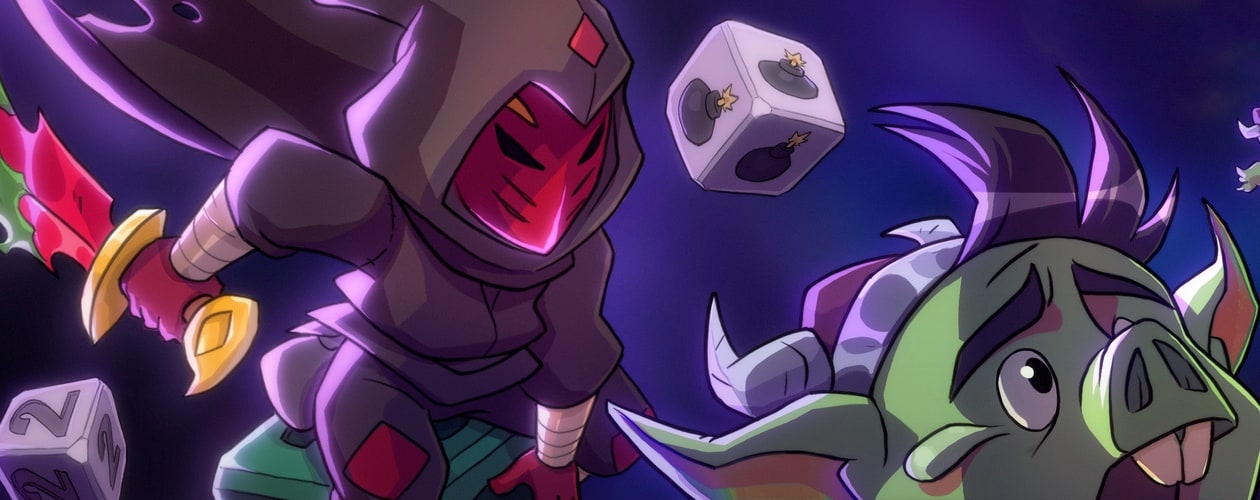

Rune Dice might be a deck-building combat game, but that deck is full of dice instead of cards. Then there’s also the snooker-like precision with which you’ll need to throw said dice, oh, and your rolls are dealing damage in the fight you’re embroiled in at the time. It’s a lot like Peglin, except instead of playing a pachinko machine, you’re combining dice.
You begin a fight with dice of various values scattered about the game board, being handed a 1 to throw into the mess. Truth be told, saying that you’re “throwing” the dice is a bit of a misnomer, when it’s more like having a result already that you slide onto the board like it’s an ice hockey puck or curling stone.
If that 1 hits another 1, they will combine and become a 2, which will then bounce in the general direction of the nearest 2 on the board, the value of the combined dice becoming the damage dealt to enemies all the way up to a max damage of 9. Plan things well enough, or get lucky enough, and you can chain huge amounts of damage like this.
If it hits a die of a different value, though, then it will simply bounce away. This allows you to make trick shots – bounce your 1 off a 2 so they both hit an equal dice, giving you 6 damage, then they bounce towards other dice hopefully continuing the chain. Unsurprisingly, this is incredibly satisfying, quickly turning risk into huge rewards. I’ve finished entire groups of enemies in one round with a trick shot that compounded into lengthy chains.
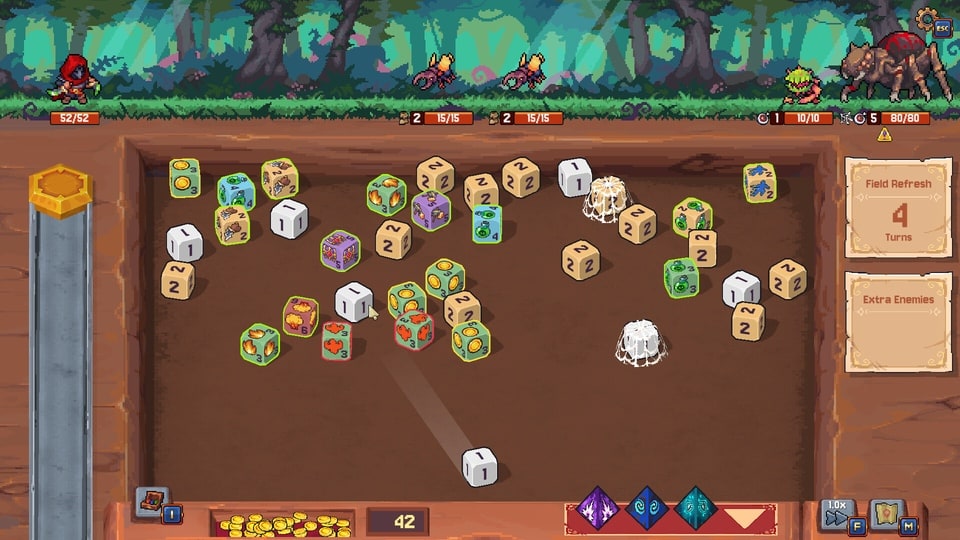
It is incredibly satisfying… most of the time. There are some shenanigans with dice bounces after combining that can cause them to miss with little you can do to influence it. I’ve had dice manage to bounce all the way across the game board to hit and combine with the only other equal valued dice on the board, but I’ve also had dice fail to connect with anything when surrounded by equal valued dice as well. You can consider that some additional randomness and still have plenty of fun though. Just bear in mind that the board resets every few rounds – if it didn’t you’d run out of dice – so if you don’t use your highest valued ones you may lose them.
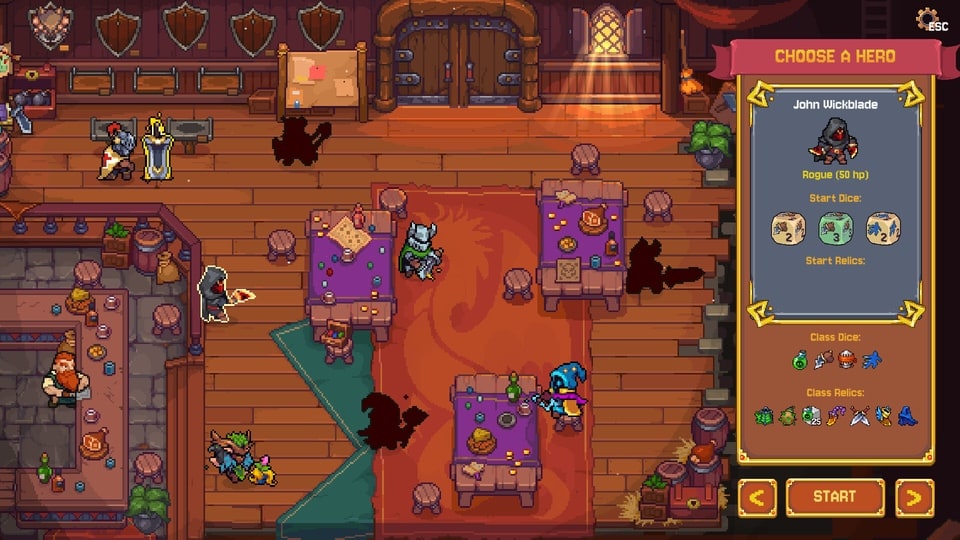
That’s especially important for the special dice. The class you choose at the start of a run comes with its own special dice to use. The rogue, for example, has a dodge and backstab dice that let you avoid some incoming damage and deal additional damage. The only thing more enjoyable than getting lots of damage in a round is also managing to get enough dodge to avoid any damage as well. The other classes work quite similarly so far, with the warrior having a shield that’s equivalent to the dodge, for example. There are also coin dice, which grant you cash when you combine them, which aren’t class specific.
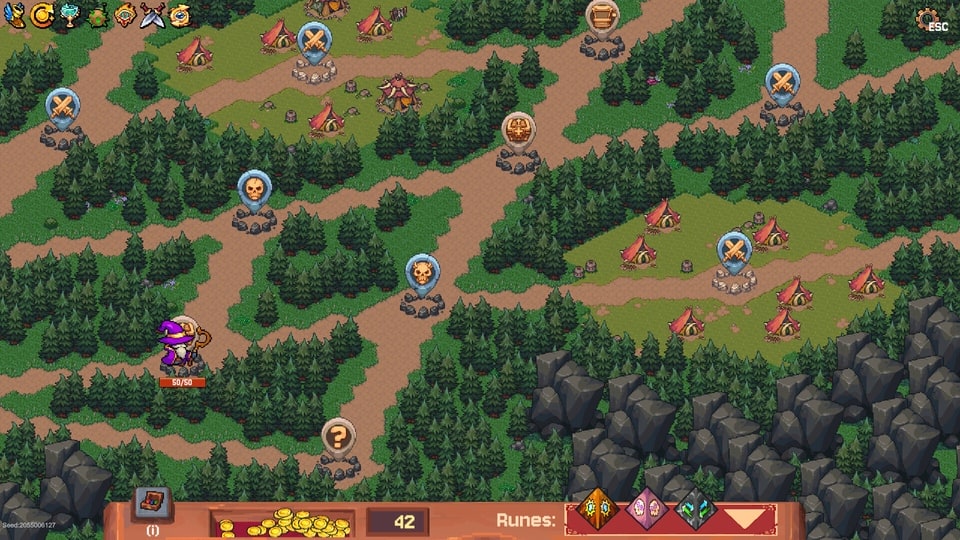
The fights are connected together by a pixelly world map, choosing which paths to take by considering the encounters available. Standard battles, tough battles, and mini-bosses are the obvious ones, but there’s also a jester that can upgrade or heal you based on a single throw, which is pretty smart though inexplicable, plus an altar that can give you a chance to upgrade a die. There’s also the customary shop that is the most reliable option for finding items, which are more rare than health and runes in encounter rewards. Items will give you a bonus or change an ability. One allows you to take another shot each round if your first doesn’t combine any dice, which is very helpful for practicing your trick shots, whilst another changed the launch dice from a 1 to a 2, which is huge
Runes are consumable items that can be used during play. Gravity, for example, pulls every dice in a radius towards the centre, which can be extremely helpful when they’re all similarly valued. Trigger collates all dice in a smaller radius to add them to damage, though also consumes the dice rather than combining them. Other runes can give you a shield, upgrade all the dice on the board by one rank, and so on. Basically, they’re very powerful when used at the right time and can really save you when things are going poorly.
It all combines into an enjoyable roguelite, though there are a few snags. Firstly, runs are very short, and can be beaten in half an hour – basically they end just as your build starts to get good. Some of the bosses also have guaranteed damage, even if you shield yourself or dodge, in the form of poison that applies regardless of defences – this has caught me out several times and discourages using a defensive build when they can circumvent your shields.
The other issue is that the game doesn’t change much as you keep playing. Most roguelite games evolve as you unlock more stuff, making you more powerful, and either getting more challenging itself or giving you access to more difficult areas. That doesn’t happen here, partly because of how quickly you’ll reach the final boss. It makes the game feel shallow because you don’t get long or have reason to really tinker with your character build.