Transport Fever 3 is a tycoon game specifically about planes, trains, and automobiles. And boats, there’s boats as well. It looks a bit like a city builder, but instead of fussing with zoning for industry and utilities, you’re setting up transport. It’s up to you to help citizens get around towns, to deliver base resources to be processed, and then the resulting products to a town that needs it so it can grow. It’s an enjoyable idea, filled with logistical nightmares for you to think and plan your way through.
A game of Transport Fever 3 is generally quite simple early on. You’ll begin with a headquarters for your logistics company, of course, then a road depot and some stops in the three sections of the city – residential, commercial, and industrial. Then you can connect them together with your first line, likely with a stage coach that can move four whole people at a time – five and two horses, if you include the staff! But that’s good actually, because this is far enough back in the past that maglev hasn’t been invented yet.
After you’ve facilitated the free movement of people around this town, you’ll want to set up some resources. Every village has two resources it needs to thrive and grow. As an example, let’s use planks and fish. Planks have you setting up lines to take wood from a forester to a sawmill and then run those planks over to the hamlet in need. Fish are perhaps a little more complex, as you need a nearby fishery, a dock, a ship depot, a warehouse, and a station for transferring all those fish. Everything can be quite straightforward if nearby, but increasingly complicated if you need to cover large distances.
With its demands met, a village can grow, increasing its demand in order to become a town and requires even more resources. Except this is only one town on this map of many, each requiring different resources, each near differing suppliers, and all of them utterly helpless unless you come along and use roads to connect them all up.
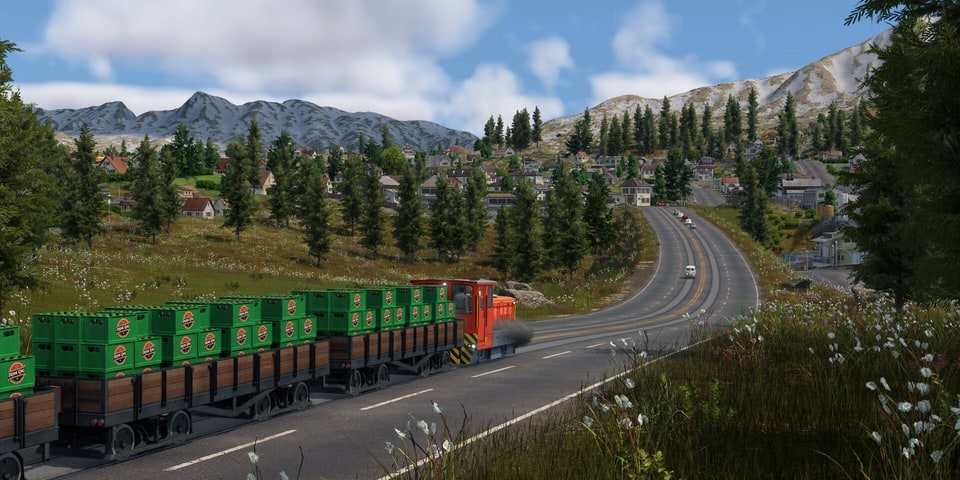
It is basically a strategy sandbox. It drops you onto each map and sets you as the only person to connect everything and everyone together. It starts out slightly more complex than expected and only gets more so as towns get bigger. You’ll have fleets of vehicles under you, all needing maintaining, and after a few hours you’ll have so many lines to keep an eye on that you’ll wish you’d come up with a better naming scheme so you could find what you needed at a glance. The game does a good job of helping with this though, allowing you to mass-rename them based on a quick selection of autogenerated options, as well as allowing you access the lines in a town via the town’s own interface.
That is the important part here. The game is incredibly deep and complex, but it gives you enough support and quality of life features to ease the burden. Five hours into one of my runs I made a stupid mistake, completely forgetting to build one warehouse that caused three newly planned lines to fail. The game’s notification system, however, quickly told me that goods were unable to be delivered, allowing me to fix it. I’ve played games similar to this before and they don’t always notify with enough clarity of a specific issue in a supply chain.
This is a collaborative process, you’re helping people and businesses thrive, so they do the same for you. You’ll also have access to subsidies where a particular business or town will pay you in advance and upon completion to deliver a specific resource or ferry some people somewhere. These are useful not only because of the money, but because they’re also pretty good hints of what you could work on next. Without this, there are a lot of options that could lead to a touch of decision paralysis.
That’s also helped by the campaign, which has a bunch of scenarios based around key historic events. You’ll help put on a great Mardi Gras at the start of the century, save Woodstock in the ’60s, and generally get to learn how the game works through this mode before cutting loose in the full sandbox mode.

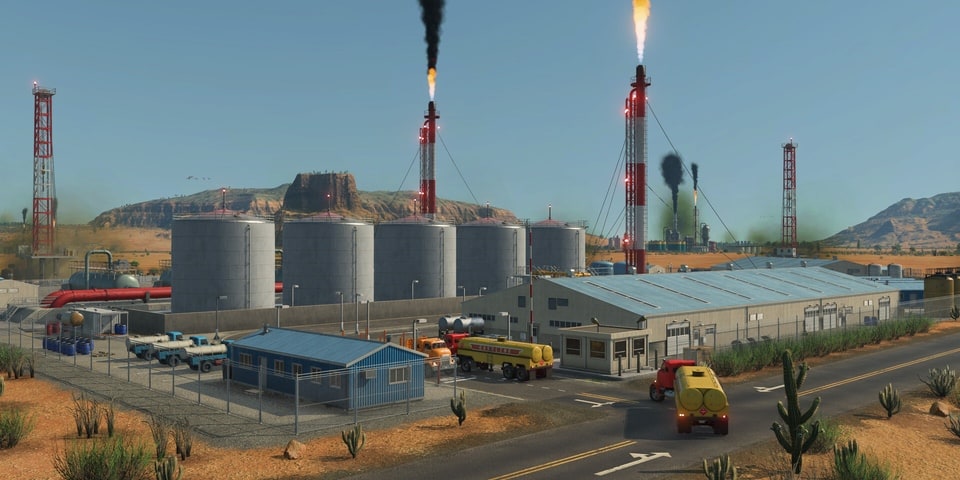
The game looks pretty good on console. It’s not going to blow your mind but you can zoom all the way in and it doesn’t look too bad at all. No frame rate stutters or graphical issues either, it runs just fine even when I zoom all the way out. There are a lot of vehicles in here as well, ranging from the 1900s, going through the decades up the modern day. It’s a transport nerd’s dream. I’m not quite there myself, but I still appreciate the effort.
There are a few other issues playing on PS5, which are UI related of course. It is a bit fiddly early on when you’ve only got a few lines to think about, but by the time you’ve got 20 of the things you’ll be sick of scrolling all the way through them to get to what you need. It can also be incredibly awkward to manage upgrading your fleet of vehicles, not just remembering what goes where and why, but actually using the menu effectively with a controller to figure all that out is a bit of a pain as well. I generally just picked one and hoped for the best. Also the tutorial stopped working for me, it just stopped suddenly and never came back up, I’m still not sure why.