

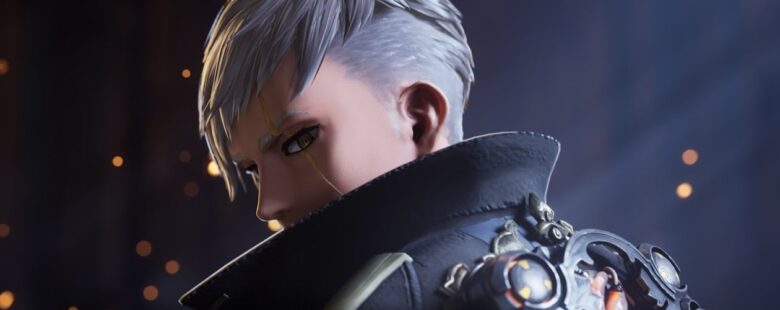
Code Vein II is so much more than I expected. As much as I loved the first game, it was pretty plainly “anime Dark Souls” at a time when soulslike competitors were still relatively few in number. It was successful enough to earn a sequel, and so I naturally expected to find something immediately familiar in Code Vein II. By the end of my time with it, though, I was blown away by how original, engaging, and uncompromised the vision for this game is – and how much I loved playing it.
In my first couple hours with the game, I thought I had my answer locked in. “Oh my gods,” I thought as an expansive open world and motorcycle were revealed to me, “this is anime Elden Ring!” You’ve got statues you activate to rest, level up, and respawn enemies. When you die, you drop your earned currency and can recover it if you return to that spot before dying again. If this was the height of the game’s ambition, I wouldn’t have been offended at all. Code Vein II is set in a gorgeously haunting post-apocalypse world, full of abandoned cities and toppled towers and cold, lifeless beaches that said so much with so little. It’s a massive map, that slowly expands as you progress through the game, and right out of the starting moments I was in love with simply wandering away from my specified destination to explore and poke at corners and fight hidden enemies.

There’s more to this, though, and while some of it snuck up on me over time, one of the immediately noticeable elements that makes Code Vein II so unique and ambitious is its story. Code Vein II is, when you boil it down, a post-apocalypse vampire time-travel doomsday adventure. It throws all of that at you at once, and some of it doesn’t immediately stick. My quest to travel 100 years into the past with my time-traveling companion Lou – who sacrificed half of her glowing golden heart to revive me, by the way – makes total sense to me. As does the goal to learn some secret from the past to bring back the powers of legendary heroes and then to defeat corrupted versions of them and prevent a doomsday event from triggering in the present. Some of the finer points are muddy, but it’s an interesting muddiness where some things feel a bit underexplained, while others feel purposefully brushed aside to hide the true intentions behind my quest.
It’s honestly fascinating to be tossed into a world like this that has lived, died, and lived again for hundreds of years. The game expects you to know a few things that I definitely had to visit the in-game glossary to understand, but the meat of the narrative experience lies in the untraditional use of time travel – it’s shockingly simple compared to many Japanese time travel games. It acts far more as an emotional ignition, if anything. You spend hours in the world of a century ago, bonding with these heroes and learning so much about them. To return to the present and fight those familiar friends as corrupted bosses genuinely carries weight to it. When you’re then given the choice of going back to save those new friends at the risk of altering or destroying your current timeline, the weight of those choices felt so real.
So, narratively, there’s a lot more going on with Code Vein II than just vague item descriptions and implied lore. Combat and gameplay, similarly, add on a lot of interesting layers here that go beyond what might be familiar. Surprisingly, almost none of the systems or finer mechanics from the original remain in the sequel. Blood Veil armor from the first game is gone entirely, for example, and you now have access to all clothing options within the character customisation, which is easily the most in-depth character creator I’ve seen in a while.

I’ve never played a game that let me pick custom nail designs and colours for my character, curl my characters hair at specific angles and lengths, or let me enable, disable and combine layers and pieces from different outfits together to create my own fit. It’s a thrill, and I might have spent about as much time creating my character as I did playing through the entire first section of the game. I can’t wait to create more characters as soon as I’m done writing this and go deep on a Photo Mode session with all the poses and dances they provide.
But once you’ve finally settled on your look, then the real character building begins. You’ve got a wide variety of gear types to think about in this game, but instead of creating a build with levelling up certain stats and choosing gear to match, it’s your gear combos that dictate your stats, speed and gameplay style. There are primary weapons, special Bequeathed Formae weapons, Formae abilities for your main weapon, defensive Formae shields, Blood Codes, Jails, and Boosters. Blood Codes and Boosters establish your base stats, and the rest of your gear have specific stat requirements – if you overload on certain stats, you’ll trigger negative results like stamina loss or health drain. If you balance it carefully, though, you can also trigger positive effects that can outweigh those debuffs. I usually stayed within the means of my stats and never played with the risk/reward of these stat boons, though.

Weapons range from short and swift to large and heavy to interesting ranged hybrids, like bayonet-equipped rifles and floating energy blades. They can be equipped with up to four unique Formae abilities, and those abilities use up Ichor to activate – as do your Bequeathed Formae weapons and some Formae shields. Primary weapons and the Formae abilities you give them are what dictate your playstyle the most, and I loved experimenting with their properties to find a certain attack loop or Formae ability that really clicked. The Bequeathed Formae, though, never really stood out for me. Early on, they either do very little damage, or have far too much windup and wind-down time, and just aren’t worth the resource-drain or risk. Formae shields are great, though. Some are standard shields for blocking, some can only be used to parry, and one in particular that I fell in love with gives you an invincible spirit-dash that uses up Ichor but is so, so satisfying.
To build that Ichor back up, you’ll use your Jails. Each of these is a very different sort of special attack, but they all do two important things. First, landing a Jail attack will restore some Ichor, and second, the more damage you do with your primary weapon leads to higher damage from a follow-up Jail attack. I actually found the Jails to be the most transformative part of my builds, because being able to reliably build up Ichor can drastically change how you play the game.

For a while, I was running with a build where my Jail was a medium-range scorpion stinger that knocked back fodder enemies. I ran into a massive boss that moved too fast and too far to reliably hit with that Jail, forcing me to swap to an entirely ranged Jail that summons a hoard of golden bats who peck at your foe and periodically feed you Ichor. With that new ranged Ichor resource, my Formae abilities and dodge were constantly available, and I beat the boss on my next try. That loop of experimentation and build-altering happened a lot for me, and it was always satisfying having a reason to try out so many new things.
Another big part of your arsenal are your partners – the NPCs who follow you everywhere. You can pick one at a time to join you, and each one brings a different combat style and different buffs to your own stats. Interestingly, you can also “Assimilate” your partner, absorbing them into your own body so they’re no longer helping you on the field, but lend you additional buffs and stat bonuses as a result.
Code Vein II is getting some flack for removing the co-op feature the original game had, and I thought this partner system might be designed in a way where that lack of multiplayer made sense, but I’m not so sure. The feeling of isolation playing by yourself is engrossing, and it’s fun to have my partner be an NPC I bonded with through the story and not, like, my buddy Alex. But the first game also had that energy to it, and still had co-op support. I get the feeling that technical limitations were at play here more than anything else – this is a big, gorgeous game, but it also struggles with the frame rate on PS5 at times, whether I’m playing on quality or performance mode.


