
Every September there’s the eternal question of which football game is going to be the better buy for fans of the digitised sport, but for the first time in what feels like forever, that’s no longer just a two horse race. Sure, if you want a top of the line game of footy, it’ll be PES 2018 or FIFA 18 on PlayStation 4, Xbox One or PC, but now there’s FIFA 18 for Nintendo Switch. Can a bespoke take on FIFA for Nintendo’s plucky upstart get close enough to the big boys to be a worthy contender in its own right?
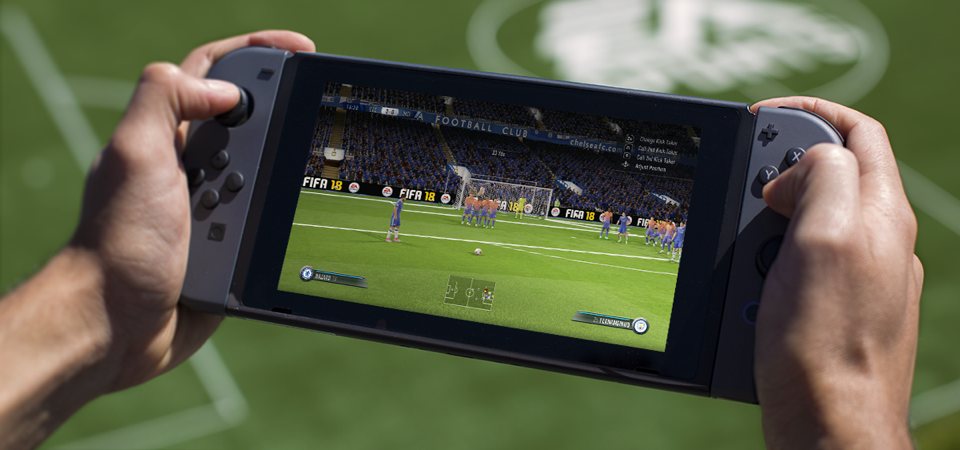
The game on Switch is certainly rather handsome, and easily the best that this game has ever looked on a handheld. It’s obviously vastly superior to what we saw on PS Vita, but it’s also a step above what has been achieved on PlayStation 3 and Xbox 360, managing to hit the heady heights of 1080p60 while docked and 720p60 while in handheld mode.
It’s running on an offshoot of the older Ignite Engine that was used for FIFA 14 through FIFA 16 on current generation consoles, as opposed to the Frostbite Engine that was adopted last year for FIFA 17. That means that in comparison to PS4, Xbox One and PC, there’s a clear graphical difference. The lighting in particular is dramatically different with the same season and time of day settings, resulting in an image that’s more vibrantly colourful and further away from the recreation of broadcast TV that EA have aimed for of late.
It still looks good, but you also lose a lot of detail such as, for example, the pitch degradation from football boots digging into the ground, but it’s much more pronounced as soon as you get the in match breaks and replays. Player models are much lower in detail and don’t have things like wrinkling of shirt fabric. Facial animations are practically non-existent outside of a bit of mouth flapping and hands are in rigid open palm positions, which makes it look amusingly like a puppet show when they try to clap or shake hands with another player or official. There’s also this general feeling that the players aren’t really attached to the surface, which is made more apparent when players of different heights are forced into a particular celebration.
This is really nit picking, because there was never any real chance that the Switch version would be equivalent to the game on PlayStation 4. It’s mightily impressive for a handheld and still very respectable when docked, but some people may find that they’ve been spoiled by the Frostbite engine versions of the game.
The game is remarkably feature complete on Switch with almost everything making the jump – the main exception to this rule is The Journey: Hunter Returns single player story, which was only made possible via Frostbite. You’ve got regular career modes, simple local play kick offs, multiplayer, Women’s International Football, as well as a full representation of FIFA Ultimate Team and it’s range of single and multiplayer modes.
However, you’re also missing out on being able to invite friends and play a custom match against them, and Pro Clubs is nowhere to be seen as a consequence of this. What makes up for this is the ease with which you can play with and against players sat right next to you. You have Local Seasons, where you play against someone nearby over an ad hoc connection, each of you with a Switch in hand, but you can also play with a single Joy-Con, so there’s two player multiplayer with you wherever you go. You lose the right stick for pulling tricks and some of the finesse options, but even with a single Joy-Con you have a good amount of control over your players.

On the whole, the game feels a little faster to play and a little twitchier as well, thanks in part to the smaller controls and analogue sticks on the Joy-Con, but also from what feels like differences in the physics, collisions and animation blending on the lower powered hardware and different game engine.
Sadly, the game can feel a little ropey at times. I’ve had the game effectively freeze while it waits for the next animation or replay to be loaded in, with players simply standing around and idling for much longer than 10 seconds – 34.4 seconds is the record – and Ultimate Team is still very dependent on your connection to the other player, with regular stutters and hitches when playing with a poorer connection. While performance is generally excellent, I have noticed a little bit of stutter in regular play, and the AI on Semi-Pro difficulty is prone to making some bloody weird decisions that see them dimly knocking the ball out of play or overdo it with trick dribbling. These are hardly major issues in the grand scheme of things.
At the end of the day, while EA are claiming that this version of FIFA should be considered a counterpart to the versions on PlayStation 4, Xbox One and PC, it’s perhaps more akin to FIFA 16 on those systems, with EA using this as a base from which they can add and remove features as necessary. It feels like EA are testing the waters with this release before they decide on how heavily to support the console. Certainly, the quite notoriously tricky Frostbite Engine has yet to make the leap to Nintendo’s console, and we won’t see The Journey appear on Switch unless EA decide to make that happen.
While it’s not on the same level as FIFA 18 on PS4, Xbox One or PC and loses out on some key features as EA target a handheld experience, FIFA 18 for Nintendo Switch may well be more than good enough to meet your demands. However, here’s hoping that EA add friend list play on Switch – in fairness, Nintendo could also do a better job in creating a proper online network for them to hook into – as well as seeing the return that they need in order to invest further in this platform in the next few years.