
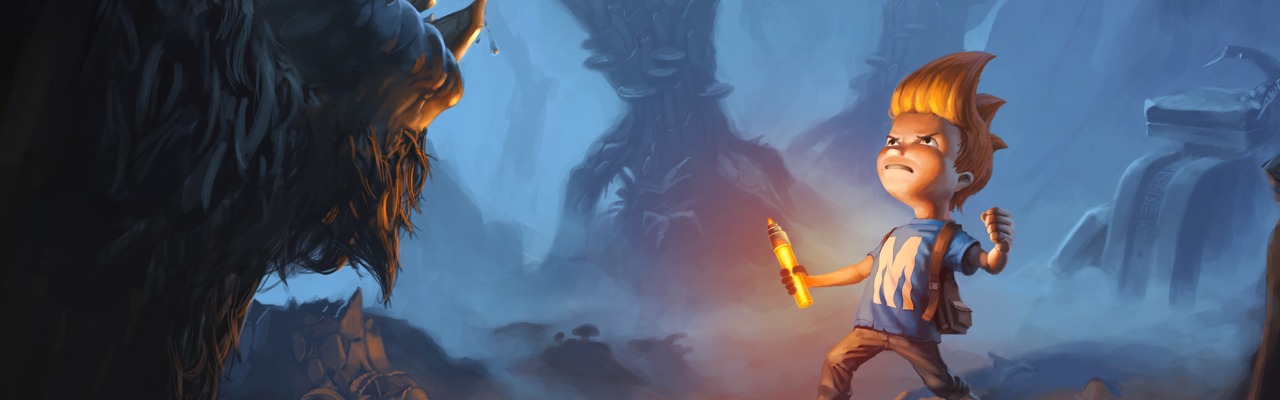
Max instantly regretted having his brother kidnapped by monsters from another dimension. I’m sure all of you with siblings know what it feels like to come home and find them messing around with your stuff; breaking your toy dinosaur, and just wanting them to go away!
In Max’s case, this actually happened, but he immediately dives through the portal which opened up in his room, to try and rescue his brother from the evil wizard Mustacho who has kidnapped him. On his way, he soon meets a friendly witch, who offers to enchant and possess Max’s greatest weapon… which just happens to be his marker, and imbues it with new powers.
There have been a lot of changes since the original game, Max & the Magic Marker, with the stand out being the graphics engine, as I played on the Xbox 360 – the Xbox One version is still a while away from being shown publicly. It’s a lovely counterpart to the CGI introduction, with some nicely stylised visuals, and with Mikkel Martin Pederson, the game’s Lead Designer, citing the classic Heart of Darkness as an inspiration both visually and for some of the difficulty.
It affords them the ability to play around with the camera in this 2.5D world, and better create the atmosphere or scale they want to achieve. It might be very close up to Max, in a dark and foreboding area, or could swivel just a little to show the true size of a huge wall which Max has to scale. Some of the scenery is truly vast.
Getting through the world is rarely your straight forward platforming fare, and you’ll have to think your way through each situation the game presents you. Looking before you leap is rather wise, particularly because where you’re going to leap is likely to be an uncross-able river or filled with enemies who will kill you upon contact.

This is where the Magic Marker comes in handy, but it’s not quite how it was before, and is presented in a far more constrained fashion. Mikkel related how with the first title a lot of puzzles were too easily skipped by almost cheating your way past; creating a stairway past a given obstacles.
Here, the Magic Marker can only be used in specific points, giving Press Play much more control over the puzzles and how you might want to solve them. That isn’t to say that I wasn’t able to come up with an unusual solution or two which Mikkel hadn’t seen before, but in general, the more accepted solution should be more obvious and easily attainable, to the extent that they’re barely putting any tutorials of HUD features in the game at all.
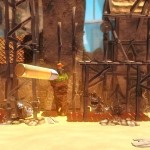
The early parts of the game see Max’s marker given the ability to create earth pillars, raising platforms out of the ground in order to reach higher places. The points at which you can do this are marked quite clearly, and you have to bring up the marker with the left trigger in order to draw from that point upwards, pulling earth towards the sky with the analogue stick. To delete a marker-based creation – none of which can be altered – it’s a slightly trickier swipe across the pillar to make it crumble.
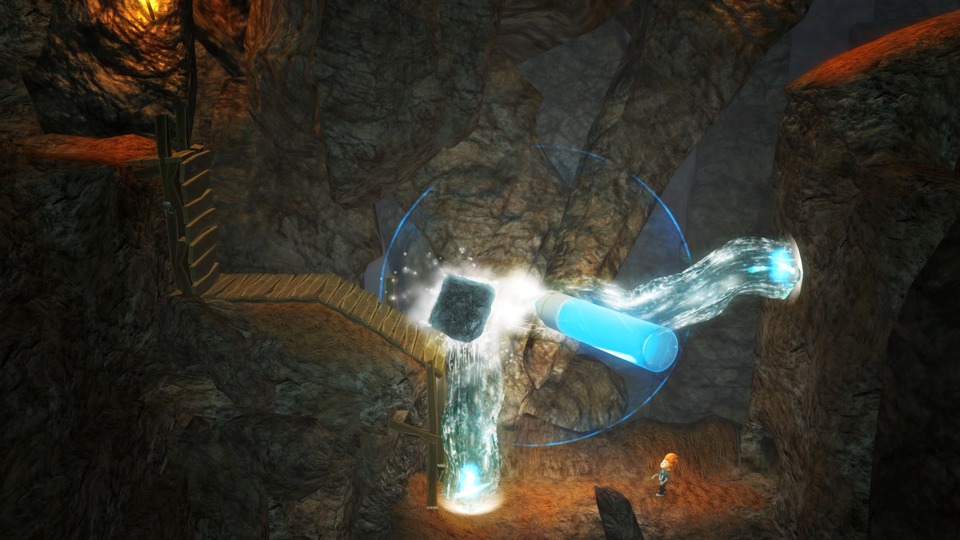
Right off the bat, it puts you into a few slightly tricky situations. Getting Max into position on top of the pillar before lifting him up on it, with an enemy bearing down on you, or manipulating a box into a particular position, to reach a rope. Each puzzle is carefully dictated by the length to which each pillar can grow.
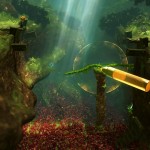
The gameplay evolves, though, as the marker gains more powers. Being able to grow vines, and chop them down to make a floating platform, and letting you summon jets of water to propel you along the lines which you draw.
There’s some tricky puzzles as a consequence, and although it’s the level which chooses which power is being used at any given time, when these elements are combined, there is the potential for some truly devilish little brain teasers.
As Max travels from area to area and new abilities are discovered, the style of puzzle transforms to suit. As I mentioned before, some puzzles might be time-based, and the early areas with the rock pillars are more to do with platforming, but once I had moved to the later area with water jets, it was a much more considered and pressure free space, concentrating more on the artistry of drawing and connecting the streams together, before shooting Max up to the next ledge.
I do have a few minor reservations, that the puzzles might feel a little too restrictive, when coming from the more open and free-form original game. However, at no point did I really feel stuck, and I was able to progress without the need for the game holding my hand, or Mikkel leaning in and telling me what to do. It’s not necessarily for young kids though, needing a knowledge of a gamepad to get through.
I really quite liked this new Max game, finding it a pleasure to play, with some inventive puzzles married to the lovely visual styling. It’s quite fascinating to see the directions they’ve taken, compared to the first title, producing a much grander game in the process.
Max: The Cure of Brotherhood is set for release on Xbox 360 and Xbox One in 2014.
Bilbo_bobbins
this looks really good. Keeping my eye on this.