

Nothing is ever black and white where morality is concerned. Beyond the grand generalities imposed by our evolution and lent further credence by our religions and cultures, morality is such a very personal concept. What’s right for you is not always necessarily right for me. Even our generally-accepted societal rights and wrongs are often easily called into question. So it’s not an easy concept to deal with in the, often binary, world of videogames. In a world created entirely of ones and zeros, it’s not always easy to represent the many shades of grey.
inFamous has always come with a kind of simple branching morality system and Second Son embraces that hard branching once again. There is no incentive to make your own judgement of situations and select an option accordingly. You’re told which is good and which is bad and you’re better to lean hard into whichever path you choose at the very beginning – otherwise you won’t upgrade as swiftly and you’ll always be lacking the more interesting abilities.
The player’s own moral shades of grey don’t matter – the game has its own clearly defined rights and wrongs and we simply select the next option on the path we have chosen to follow. That makes the progression of powers a much simpler set of systems to control and it gives the player some degree of agency in the protagonist’s development throughout the game.
It creates this illusion of being directly involved in the hero’s journey that is central to the game’s narrative progression. But it also clearly defines what the game – and, by extension, its creative team – sees as right and wrong and that can throw up some peculiar anomalies for anyone who doesn’t entirely sympathise with the exact moral framework of the game.
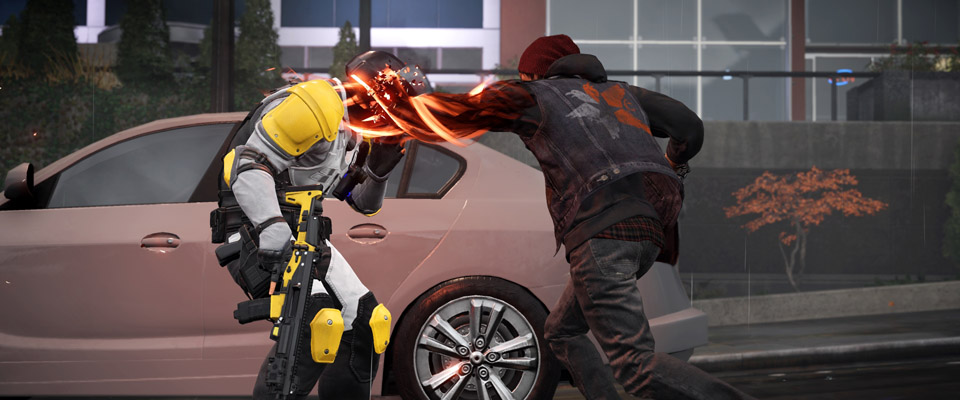
Playing inFamous as a good guy, you only have to fight for as long as you’re resisted – when your enemies give up a heroic player will stop hitting them and pin them to the ground. Playing as a villain allows you to kill rather than restrain, so there is an extra little leap of detachment that the player must take, and perhaps that’s played out by the current trend towards playing games with moral choices as the good guy – currently Second Son’s completion ratio is 2:1 in favour of those with good karmic choices.
This is also born out in comments made by Second Son’s creative director, Nate Fox, who said that he would have liked the “bad” ending from inFamous 2 to become canon but that the overwhelming majority of players had experienced the “good” ending and this forced their hand. The whole series is named for the player to push the protagonist towards selfishness and yet most of us still try to be the hero, albeit a terribly violent one.
It’s reasonable to assume that, as people who regularly enjoy console games, we’re relatively comfortable with the position of simulated violence as a force to assert our moral choices within that simulation. We can accept that, at least in this virtual world, violence is sometimes necessary and we can take that as a wholly necessary moral leap needed to enjoy this game – and most others, for that matter.
Videogames don’t leave much room for the avowed pacifist so let’s take the leap over that particular moral quandary together so that we might better explore the more unique and interesting issues presented by Second Son.
Let’s talk about drugs, vandalism, terrorism and tyrannical abuse of power. Let’s talk about erosion of civil liberty, collective fear of change and persecution.

While playing Second Son, I was struck by the dichotomy that’s presented by the drug bust incidental missions. For those who are unaware: the game awards you good karma for violently breaking up gangs of thugs around a supposed drug deal. The game tells us that this is a good thing to do. No spoilers here, but there are some other occurrences of drugs and drug culture dotted around the game too, none of them are ambiguous in their message at all.
It’s a binary generalisation that throws a blanket definition over a range of substances. Are they medicinal drugs, smuggled in from Canada and being traded on the black market because of the USA’s expensive and prohibitive healthcare system? Is it something like marijuana, which is at least questionable in its continuing status as a harmful, prohibited substance, or are these drugs one of the highly addictive, life-destroying kind that are the bane of many an addict’s life? Do the people selling them deserve to be subjected to our protagonist’s super-powered violence? The game’s stance is clear: drugs are bad.
And yet vandalism is regularly depicted as a good thing. The protagonist’s stencilled street art aside, the player is regularly encouraged to destroy property that has been publicly funded and commissioned by a democratically elected government. We’re encouraged to violently attack people who, it can reasonably be assumed, are simply doing a job they believe to be morally acceptable in order to provide a quality of life for themselves and their families. And we beat them, burn them, restrain or execute them.
The game makes the assertion that drugs are bad but that casual acts of extreme violence and destruction of property are perfectly acceptable.

We’re encouraged to think of our protagonist as the spearhead of a struggle against an abuse of power that has corrupted those in charge, manipulated public concerns and enthusiastically eroded civil liberties in an attempt to persecute differences. But what if our protagonist is really just a terrorist, violently opposing the will of a free people and the actions of the government they elected? What if he is simply a violent thug, using his newfound abilities to selfishly pursue his own campaign of vengeance against those who have done him wrong?
Perhaps those specific questions of perspective are better explored more comprehensively in a future column but it’s always worth remembering that we’re only hearing one story here, and one experience is not necessarily the universal experience. Much more pertinent to the point at this time is the arbitrary decision that the game makes about the morality it portrays. Would we be better served with more ambiguity or are the broad strokes that inFamous has always dealt with suffice for the experience it delivers?
I’ve always been a fan of the series and I’m finding Second Son just as enjoyable to play as ever but I can’t help wondering if a little more subtlety and nuance in its messages might deliver much more impact for its narrative. Perhaps a few more shades of grey might make for a significantly more interesting exploration of the characters and questions of morality of the situations being portrayed. In turn, that would make the metaphors and allusions of their world much more meaningful in our world.

bigchrissyc
I feel morality choices in most games, especially Infamous are never really that taxing. They never change the story much, bar a few in Infamous 2. I almost feel they add this in just to add incentive to play the game for longer, personally.
Kennykazey
I think choices should play out more in realtime with the player handling it. Like the scene in Spec Ops: The Line with the hanging.
My concern with Infamous is that you kinda have to stick to red or blue, mixing it up should be a positive, but it’s punished by having a two-way scale on power upgrades. I hope they change that for the next game to something a bit more Mass Effect like, where morality choices can be mixed up, and are separate from your upgrades.