

Without a doubt, The Tomorrow Children is a very unusual game, and not least because it’s so very different and so much more ambitious than Dylan Cuthbert and Q-Games’ most recent and most memorable endeavours. Set in The Void after some Soviet experiment or doomsday device drastically altered reality, it sees small villages spring up and try to survive in this desolate reality.
Though hundreds if not thousands of players can be in a village at any given moment, you’re not likely to see the vast majority of them at any one time. The Tomorrow Children is somewhat asynchronous in its form, where only your direct actions within the world can be witnessed by other players. Whenever someone wields a pickaxe at a wall, picks up or drops an object, or simply queues up to use the shops, they will appear for everyone else to see for just a few moments, until their action is complete.
It’s fascinating in how it’s designed to lessen the load on the servers and keep the game running smoothly, but it also gives players the freedom to feel like they’re alone and isolated on the frontier. It’s only when you turn and look in particular places that you can see flurries of activity.
For your village to grow, that activity needs to be constant. Bizarre islands periodically appear – which can be amorphous blobs, floating orb sculptures of faces poking out of the floor and more – with a bus whirring back and forth, to let you and other players travel between points. Starting with a pickaxe or shovel, you’re goal is to strip these islands for everything they’re worth before they disappear.
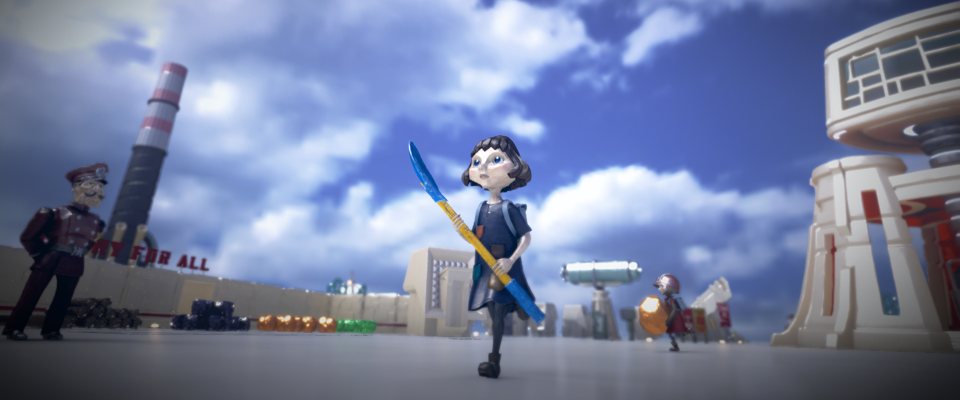
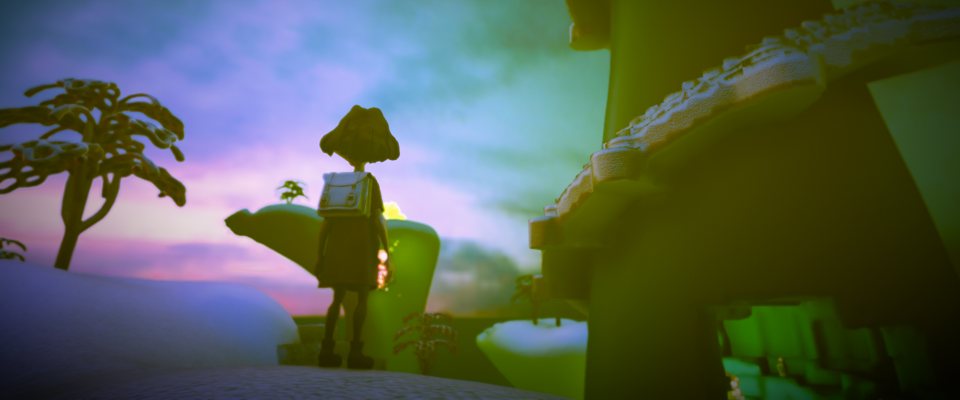
The unusual islands suit the game’s art style brilliantly, with all of the characters in the game taking on the form of living wooden dolls, and the starkness of the world they inhabit. There’s a lot of fancy visual effects that give everything a certain tangibility, but I did find it occasionally difficult to look at, especially when night fell or when heading into the darkness of an excavation.
Inside the islands are metal deposits, there are trees, crystals, and more to harvest, but they’re not necessarily safe spaces. Venture too far into the darkness and your character’s projection clone will start to weaken, with a tinkling sound and a digital fuzz. Making big holes to the outside or taking a light into the darkness alleviates that problem, but there can also be monsters inside who will readily kill you and force you to respawn back at the village.
Mining an island is a real communal effort, whether you see the other players or not. If even one person has a jet pack or a tool to create stairs and walkways, it makes getting to otherwise inaccessible areas and their resources all the easier for everyone else. However, just mining isn’t enough, and there’s the effort of picking items up, taking them back to the bus pick up and drop off point, loading it and then unloading and storing it back in the village. You can be just a single cog in this machine, focussed solely on loading the bus, or you can flit between tasks.
Whatever you do – as long as it’s something that benefits the village – you earn coupons from the state which can be put towards certain goods and items that further your character. A more expensive pickaxe can help you break down walls faster, while the aforementioned jet pack lets you fly up into the sky, and there are also weapons like shotguns or RPGs which you can use to defend yourself. Whatever it is, the more expensive versions that you buy, the longer they last and more effective they are. That’s especially true if you turn to the black market and buy goods with Freeman Dollars.
There’s a delightful undercurrent of classical Soviet stereotypes at work throughout, from the oppressive feeling messages played from TV screens and the music they pump out, to the way that the guards and shopkeepers are more than willing to make shady deals person to person, without involving the state. They bend the rules in order to sell you a weapons license or an EagleCorp Jackhammer, with a little nod and a wink along the way.
However, you want to have more than just tools in your pocket, as towns will periodically come under attack by giant monsters. Some look like metallic spiders, others have a little in common with Godzilla, and defending the village will be a priority. That’s why you’ll have your hands on shotguns, RPGs and be able to hop onto any static gun emplacements created in the game’s typical fashion.
A Second Opinion
After playing the beta of The Tomorrow Children I wasn’t overwhelmed by it. That’s not to say I don’t think there’s potential but it all felt a bit overwhelming and disorganised. When you first enter a town you’re pretty much dropped in to fend for yourself. Eventually you kind of understand the systems in play, like where the storage area is, but it wasn’t always clear what materials were being stored for the town.
I eventually worked out how to build structures but I found this to be the most frustrating part. I go to a large open space, try to build something only to have the placement thing remain red as I can’t build in the area. No indication of why except that there’s not enough or too much metadata, a concept that went unexplained.
I like the game’s design and I like exploring the places that appear in the void, though. It just lacks explanations and the tutorial at the beginning really didn’t cover much. I also found there wasn’t actually much cohesion with other players in the town. This led to people doing their own thing too and wasting resources by building the same things over and over. A small noticeboard that people could post to in the town for others to check would help counter that. The beta showed that The Tomorrow Children is a good concept, but could do with quite a bit of tuning.
– Aran
You need a building permit before you can gain a permanent residence in a village – though hundreds of players could be active in a village, you can only reserve your space on that village’s servers by building a residence. Doing so requires you to use the work bench and solve number-based sliding block puzzles against the clock. However, just placing the placard isn’t enough, as the town needs to be large enough for the state to allow for more buildings to be built, and its layout can be shaped by those who have played long enough to gain a certain higher bourgeois status.
It’s just one of a number of rather nebulous concepts which will take more time than was available in the beta to be fully revealed. In fact, a lot of the game was simply rather confusing and unclear, which will almost certainly be smoothed out prior to the game’s launch. However, it’s an unusual game which I find fascinating, from its aesthetic to the manner in which it brings players together to work toward common goals.


Kamokazi-UK
I got into the beta, only to seemingly get int to late…
TSBonyman
I was too late for the beta so i hope it reviews well as i don’t expect there will be a demo.
Eldave0
Absolutely hated my time with this game. I’m all for games letting players figure stuff out on their own (Bloodborne did this really well), but I found the whole thing a bit of a mess. Hated the visuals, hated the clunky gameplay, hated that you had to queue up at benches, etc. Just… blegh, not for me.
JR.
The art style really puts me off. It reminds me of those godawful kids programmes where they moved real figures around a miniature set.