

As FuturLab looked for an idea to turn into a VR game, they hit upon a simple and attractive concept quite early on. “Do you remember the drone racing videos that were big on YouTube, with first person racing through forests and things?” asked Dave Gabriel, Designer on Tiny Trax. “We thought ‘That’s it! That’s a VR game, that’s amazing.’ That’s what we pitched [to Sony] and they said ‘Yeah, that sounds great.'”
That isn’t Tiny Trax, though. Tiny Trax has more in common with the toys of the 80s and 90s than the latest technological fads, basing itself instead on Scalextric and adapting the slot-racer for virtual reality. It’s a lot of fun, with plenty of nuance to the driving and some fantastically varied track design – read our hands on preview here – but how FuturLab got to this point has been anything but simple, as we discovered when talking to Dave and James Marsden, FuturLab MD, about the last few years.
It’s actually a little surprising to remember that it’s been three years since Futurlab’s last release, the wonderful Velocity 2X. Tiny Trax hasn’t been in development for all that time, and in fact, working on PlayStation VR games wasn’t even their first priority for a lot of time. In that time, other deals and other projects have fallen through.
James opened up about what was a very difficult period for the company. “As soon as VR came on the scene and Sony were rumoured to be doing something, we quite early on found out that they were, and the whole team’s been excited about VR, but we were so busy with this other project which was with Sierra, Activision, when Sony came and said, “Can you do something with VR?” We said, “Sure, but we don’t have time and we know nothing about it.” We had this drone idea accepted, but we agreed that we’d postpone development until we were over the first hurdle on this new project. We signed it, put it on maybe a ten month delay.”
As the unnamed project FuturLab had with Sierra fell through, working on PlayStation VR still didn’t come to the fore. “It was always billed as a smaller project, this game,” James continued, “and we were always looking for the next big game; What’s the big thing that comes after Velocity 2X? Even though we now had a decent idea and Scalextric and Tiny Trax – it was actually called Diddy Drift to start off with – once we had that, we were still very much focussed on trying to get that next project signed.
“The three of us [myself, Kirsty Rigden and Hussain Sheikh] were doing constant biz-dev. We pitched seven different projects to many different partners over about an 18 to 20 month period, so still, we didn’t have enough time to dedicate to Tiny Trax.”
It was really a case of Dave coming to the rescue here. Having been QA Lead for Velocity 2X, his was a job that doesn’t quite fit with the early part of concept work, prototyping and pitching. So he added research to his list of tasks, which eventually became an awful lot more.
Dave said, “I did some research to try and find out what makes a good VR experience, so that when we come to test it I could suggest things to do differently. It very quickly became apparent as I downloaded all these demos of racing games and things, that I was feeling sick for the better part of a week afterwards and be like, ‘I don’t like this; our drone racing game’s going to be awful…’
“So we just had a think to try and find some other things that work, and in doing that, doing lots of research, I found one game where you’re sat still and had the world built around you, and you just moved a little character around the world. You’re leaning in and looking at it, and that was really cool. Third person games are where it’s at and coming off of that, I was thinking back to board games and things you do as a kid. Then Scalextric came up.”
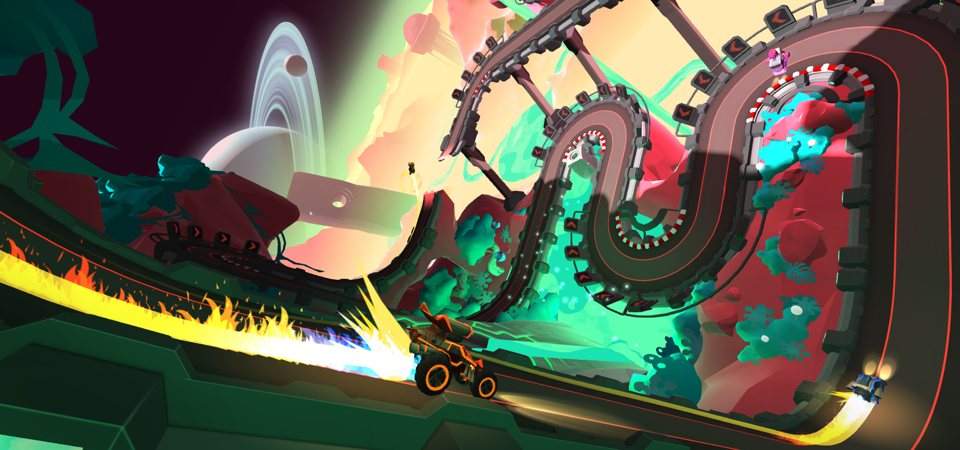
It’s a simple sounding revelation, but it’s also one that’s quite clearly come to shape Tiny Trax. Loading up a track for the first time, there’s a kind of wondrous curiosity as you peer down on the little race cars on the start-finish line, before trying to look around, following the track through from beginning to end.
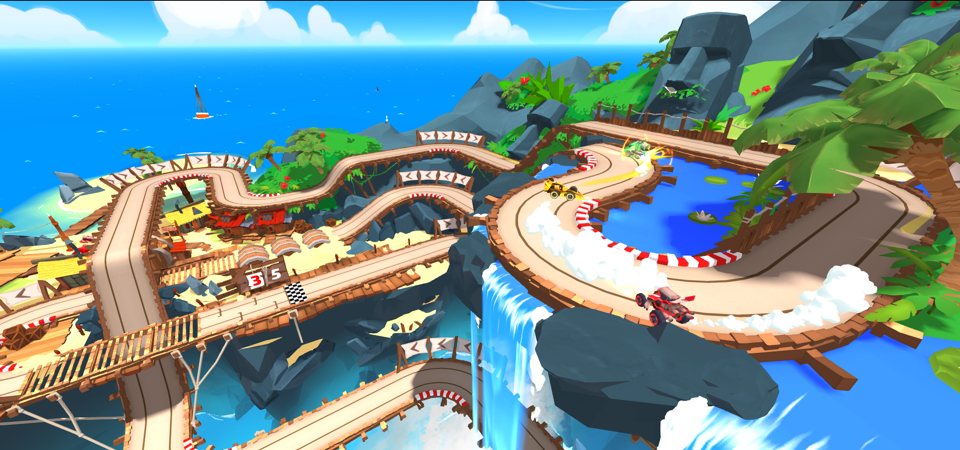
There’s a definite artistry to the track design, blending the need to create something that’s fun to drive with your fixed viewpoint. It works in broad strokes as the track comes near you, with long straights and curves, but the further away a section of track is, the more intricate it can be.
“It was looking at a lot of Scalextric and Hot Wheels, sort of professional tracks,” Dave said, “where people have spent hundreds of pounds making this big thing in their garage. You sort of think that’s easy to do, and then you realise they’re looking at the sight lines and things, which you also have to consider in VR when you’re designing a track. If can’t see the corner just before you get to it, you don’t know when to turn, you don’t know to slow down.”
“It was a really interesting challenge,” James added. “One of the happy accidents is that PSVR is quite limited resolution, so when you have a little sprite or model that goes a metre and a half away from you in real space, it breaks down, you can’t read it, you can’t see where the car is turning. You can’t have much distance or much depth to the tracks, but you’ve got upside down, you’ve got down below, you’ve got around you.
“Our very first tests were just flat, because we didn’t have the gravity fixed. […] As soon as we had the gravity and anti-gravity, we were kind of sculpting the tracks out in interesting ways.”
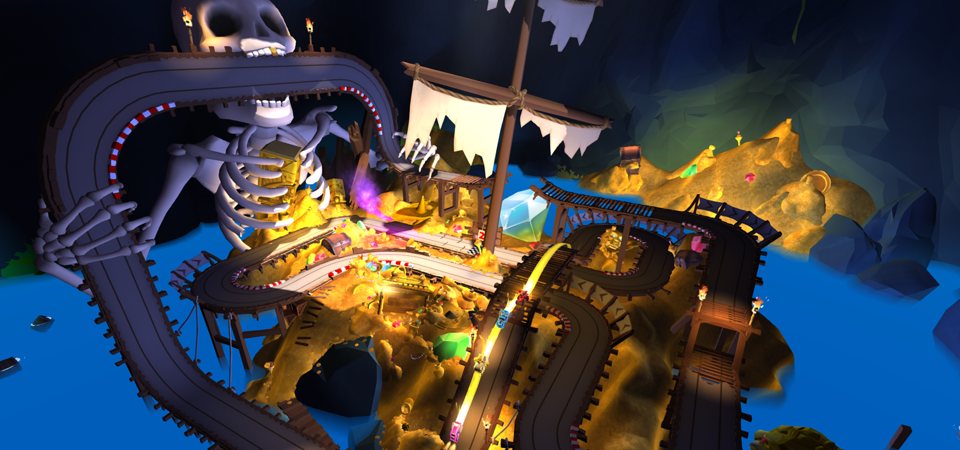
Racing around these tracks, you get to do much more than in Scalextric. With video games and virtual reality, you can twist and alter how reality works, with these tracks pulling audacious loop the loops, cars that race along walls and defy gravity, and no need to worry about speed, just turning.
“We tried to do a direct simulation of Scalextric,” James revealed, “where the danger point is going too fast. We tried five or six physics models, but it never translates. […] No matter how we tuned the physics, it was either too hard or too easy and we banged our heads against the wall, our programmer was going round and round in circles, and then Dave came up with the genius idea of making the penalty overturning rather than going too fast.
Tiny Trax is a game of firsts for FuturLab. “This is our first VR game, it’s our first multiplayer game, it’s our first 3D game, it’s our first racing game,” James said. “It’s a lot of firsts,” Dave chuckled, FuturLab’s first time game designer.


zb100
Great article, very informative!