

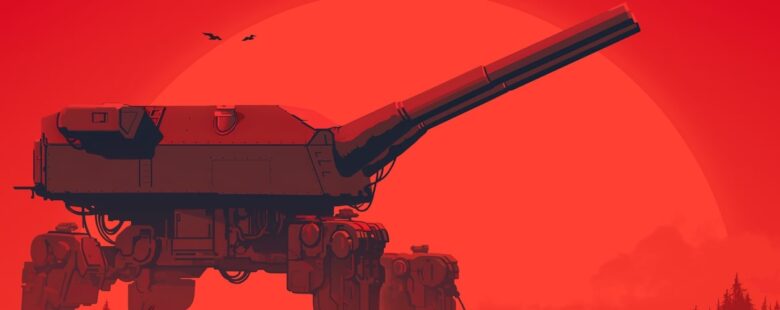
What could possibly be better than operating a massive gun turret? Okay, there may be one or two other things that might be better, but if we’re talking about game pitches, Iron Nest needs your attention. You are an operator in control of a mammoth cannon, aiming via your map, choosing your missiles, calculating angles and distance, with a stunning post-WW1 dieselpunk aesthetic to set it all off.
Iron Nest is an alternate-history sim rather than a military shooter, and that’s something everyone needs to know going in. The two-person team, Dominik Latos and Nick Talmers, told me how they settled on the setting, saying, “Iron Nest’s setting came from gameplay experimentation first. Nick found that the more automation and digital systems he removed from early prototypes, the more engaging the gameplay became, which naturally pushed the game toward a dieselpunk pre-World War I setting built around analog systems and massive naval guns. From there he built an alternate history where World War I never happened, letting the dreadnought arms race and old European power structures keep evolving in very different ways.”
That’s important, because there’s a clear familiarity with the iconography and technology of the early 1900s that gives Iron Nest a look and feel that’s wholly believable. You start off viewing a map of your turret’s layout – the massive artillery chambers, the planning space – and a pictorial plan of the gameplay loop that you’ll need to follow to succeed in Iron Nest. That starts with reading your mission briefing, pumped out of a typewriter-like printer, before measuring for and calculating your target.
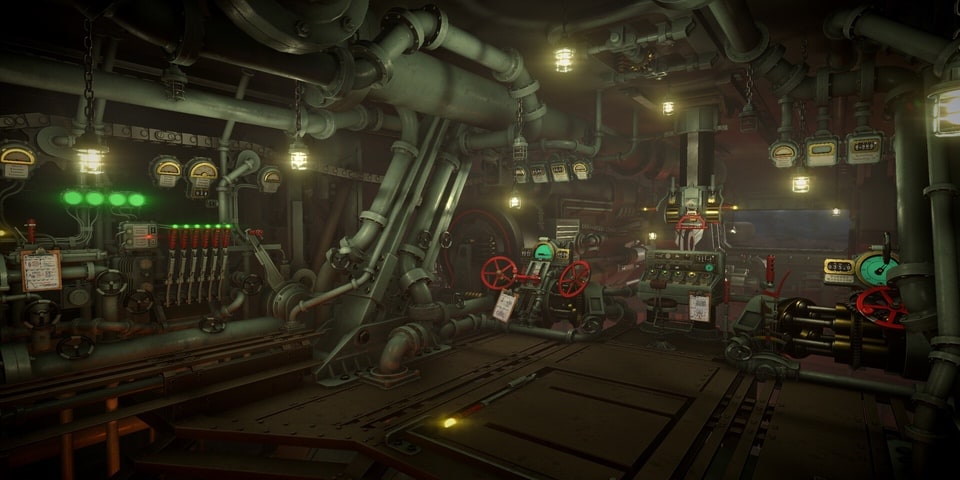
The sense of place here is exceedingly strong, and you can feel yourself pacing between the different sections of your turret, the heavy-duty pipework, pistons, cranks and handles giving an excellent tactility and weight. Walking over to the measuring table, you can see your target, and its relation to your turret, drawing out a marker that gives you the bearing and distance you’ll need to successfully hit the target. It’s recorded on a clipboard down to the left as well, which furthers the feeling of realism and the low-tech era they’re trying to evoke.
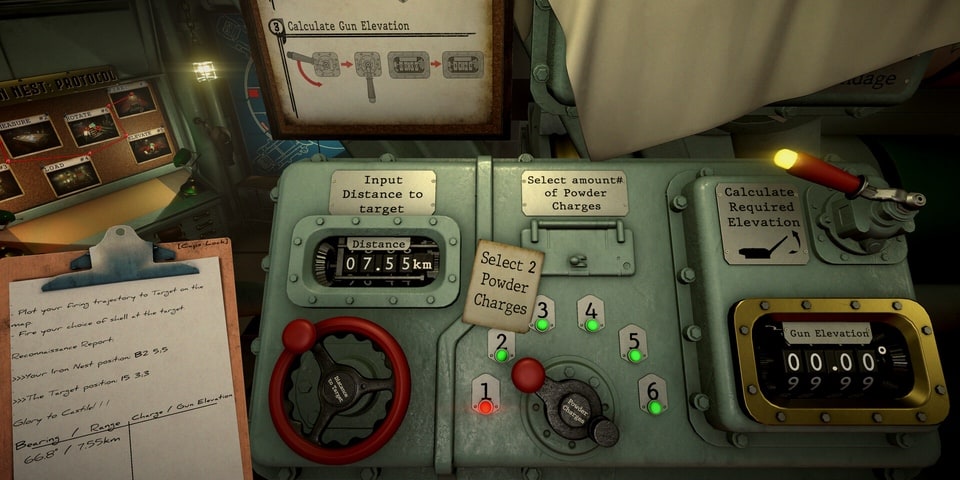
From there, we’re off to the chunky calculation apparatus, spinning the wheel to input the distance you’ve measured, before then having to work out the number of powder charges, and calculating the required elevation. You have to refer to the ballistic calculator on the wall, and it all just ties together really well. It’s one of those experiences that doesn’t necessarily sound particularly thrilling when you write it down, and yet there’s magic at work here, putting you at the centre of a simulation experience that manages to feel both grounded and otherworldly at the same time.
You then move from the more cerebral prep to the physical readiness of loading and aiming your cannon, before finally, and hopefully accurately, unleashing your arsenal at the enemy. The ballistic shots are unbelievably heavy, and that’s translated really well by the animation and sound effects that the duo have crafted. There’s an element of inaccuracy as you try to dial in the correct elevation, with a lever that’s not a 1:1 interaction, and I really liked trying to nudge it towards the correct figure, rather than relying on the crank wheel.
The believable metallic spaces, the authentic finishing touches like the newspapers and visual asides, lend Iron Nest a solidity that many games strive for, but ultimately miss. Here, less is more, with the constrained space of the turret letting you construct your own narrative reality to sit alongside the game’s setting and physicality.
The team told me, “The propaganda-heavy newspapers and articles grew out of our shared sense of humour and love of absurdity and contrast. The idea is that the player feels the gap between what they were ordered to do, what they actually chose to do, and how the propaganda then twists it all for public consumption. It’s a style of worldbuilding Nick enjoys writing, and hopefully one that players will enjoy too, discovering the world through how it reacts to and reinterprets their own actions.
When you fire, you create a satellite image that hits the map table and shows you how close you are to your target, as well as an indication of the type of targets that populate that area, letting you make a further judgement as you try to get everything just right. I think the only thing I’d like to see from further development would be a more physical tracking of the shot itself, though I appreciate that’s a bigger undertaking. If anything, the ticking seconds of the stopwatch you have, and the satellite imagery, strengthen the fiction of the setting, but I can see people hankering to see more clearly the results of their attacks.

This has been a passion project for the team, though it’s not one they’ve embarked on alone. They’re clear about Iron Nest’s inspiration: the game PVKK having still not arrived at release, even as they’re getting ready to unleash their own work on players. They told us, “PVKK, which is of course one of our main inspirations, opened people’s eyes to something that could become a standalone genre in the coming years, much like roguelikes did in the past. At first, we thought this kind of game would appeal only to a very niche audience. But after revealing Iron Nest, it turned out we could not have been more wrong. This type of gameplay seems to be much more mainstream than we initially expected!”
Besides their inspiration, they’ve worked hand in hand with fans and beta testers to get Iron Nest ready. “We believe one of the strongest things behind Iron Nest is that our community is not ‘just a community’ in many ways, it has become another developer. You could say that Iron Nest is not being created only by us, but also by the community itself. Our players, whom we call Operators, have helped us many times. Without their support, we definitely would not be where we are today.”
They continued, “We have also chosen a very open development approach, which is not that common anymore. Our community has access to Discord channels where we discuss development-related topics almost every day. This has only strengthened the bond between us and the players!”
Iron Nest is offering a very specific type of military simulation, but it’s one that seems to have resonated incredibly well with players before it’s even been released. We can’t wait to see where the team have taken the game once it arrives on 6th August.