

In real life, eight teens going up to a holiday cabin in the mountains probably has a very low likelihood of ending up murdered after a psychotic killing spree. In movies, it’s a practical certainty, but in Until Dawn, it’s really up to you whether they manage to survive or whether they all die.
As we saw back at Gamescom, Until Dawn has transformed into a very different game to before. It’s switched to the third person and uses the DualShock 4, it’s been rewritten and re-cast and, running on the PS4 with the Killzone Shadow Fall engine, it looks absolutely gorgeous.
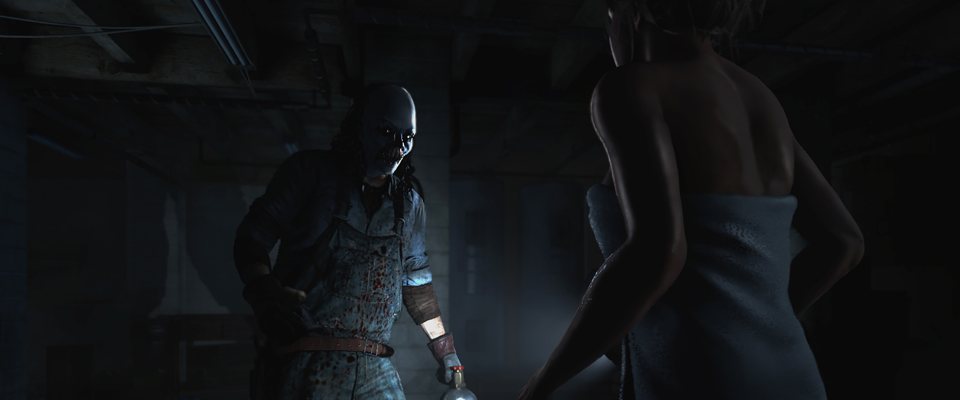
Hayden Panettiere’s visage is accurately recreated in the game, lending her face to the character of Sam – a name you might remember hearing during the suspenseful trailer. She’s quite creepily being watched as she’s taking a bath, disturbed as the clown masked killer closes the door behind him. As she finds all but a woolly sock to have disappeared, she naturally presumes it to be a childish prank, as she wanders around the dark cabin with just a towel and a torch. It’s something of a horror film cliché.
Slowly wandering round the cabin, following arrows painted on balloons, perhaps the game’s most pressing weakness becomes clear. The standard walking animations are quite stiff and stilted looking. The love, care and attention that facial animations have received can hopefully be extended here, and the flexibility increased. Should I struggle to walk around the sofa? Not really.
Yet this section ought to do a good job of building the tension – something I can’t really attest to, having seen the scene play out one way before getting my hands on the controller. A couple of simple jump scares, the dark and forebodingly empty cabin and knowing that the killer is nearby, even though Sam doesn’t. Yet.
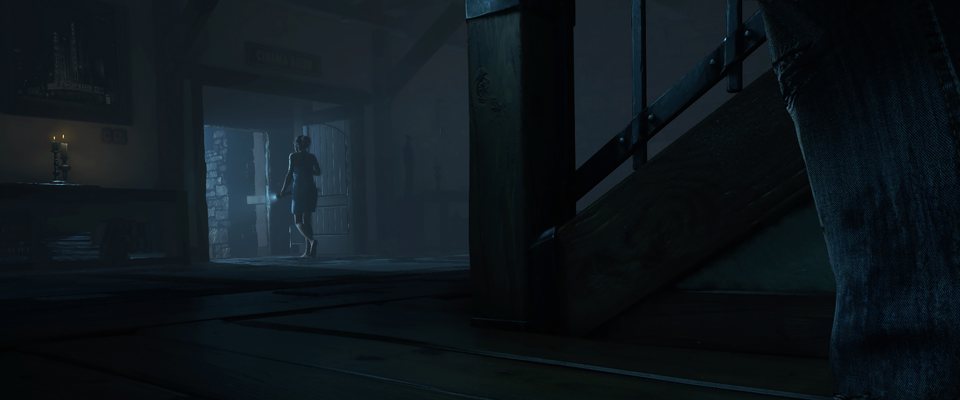
It doesn’t take too long for the killer to reveal himself and come after Sam, lugging a gas canister as he goes, and the action sequence that follows forces a number of quick fire decisions and options your way, as you try to escape. Right off the bat, you can throw a vase at him or flee, then hide under a bed or keep running.
A number of times, I was presented the choice between running onwards and hiding somewhere, and once in hiding, allowing me to chose between staying hidden and running further. Each time, it was a choice made with a physical movement of the controller, pointing to the side of the screen I wanted to follow before tapping X to select, and as rightly observed in yesterday’s interview, I had little hesitation in making my choice – though again, somewhat coloured by seeing one potential path in advance.
These points where I hid were really rather well done, though, as I first had to react and turn the flashlight off and then hold the DualShock 4 completely still, to keep the light bar icon within a rather tight area on screen. This and all the other motion controls in the game are done not by camera sensor, but by the accelerometer and other motion sensing gizmos in the DS4.
It’s also really quite tricky to pull off. Forewarned, I was able to get a fair bit further than in the PSX demonstration, picking different choices to see how dynamically the scene would flow and adapt – quite well, as it turns out. Yet, when I did hide, I wasn’t quite able to hold the DS4 steady and Sam was caught, to her seemingly inevitable demise.
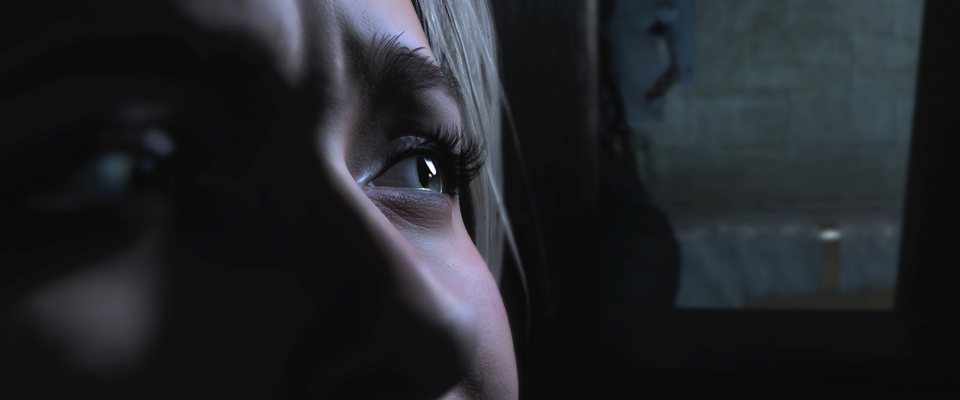
The thing is that whatever choices I made in the spur of the moment, there was never a clear and obvious one that would result in escape. Run further and the clown killer would gradually pace after Sam like a murderous tortoise plodding after a panicking hare, hide and he’d pause. You’d never know if he’d turn and look at you, wander off, or what.
Even locking a thick looking door behind Sam didn’t seem to slow him down for very long before it was kicked off its hinges. Anecdotally, running at a point in which I hid simply saw another person get killed almost out of the blue, and it’s this uncertainty which plays out at every turn. There’s an element of deus ex machina at play, if that’s the case, and Supermassive will have to tread a fine line to avoid frustrating players in that regard.
And yet, not knowing if the killer might decide to check under the bed, if the killer can smash through that door or quite how long a reprieve you have on the other side could push you to make snap judgements without trying to overthink them.
The branching decisions on the butterfly diagram are a quite powerful way of describing just how broad a spectrum of outcomes there really are in the game. That it’s made clear to the player when a decision is being saved – by way of a little butterfly logo – is interesting, but only major choices are represented on the butterfly. That something seemingly innocuous in the first act could come full circle and decide between one character’s life and death a few acts later is fascinating and should hopefully add some real replay value and variety as you make different decisions.
The only thing that didn’t seem to matter in the slightest were the few questions prior to the demo, choosing between two statements to see if I agreed with them. Whether I was afraid of the dark more than crowded spaces, for example. Then again, maybe those questions will matter in the final game?


bunimomike
Even if it’s utterly predictable, I still like the idea of this. “Predictable” might be the wrong word but I don’t really mind. I just like the idea of finally being able to interact with the equivalent of a cliché-riddled horror/slasher flick.
SamBeThyName
I think this is going to be a belter on the sofa with the wife
bunimomike
Words to live by.